For decades, non-technology enterprises have operated under an unacknowledged and uncomfortable consensus: a vast majority of their internal software platforms are fundamentally substandard. While this persistent issue is rarely blamed on the engineering talent—many of whom possess the technical acumen to build sophisticated systems—the underlying economic realities of software development have long dictated a different path. Historically, building and maintaining pristine enterprise software has been prohibitively expensive, leading to a long-standing misalignment between software quality and corporate balance sheets.
This structural deficiency shapes the daily operational reality for millions of employees working within major non-tech sectors such as banking, aviation, government administration, insurance, and large-scale industrial manufacturing. Within these organizations, employees are legally and contractually bound to use internal systems that are confusing, clunky, and structurally obsolete. Unlike consumer-facing applications, where poor user experience (UX) drives immediate customer churn, captive enterprise users have no alternative marketplace. Consequently, corporate decision-makers have traditionally viewed software quality through a lens of strict functional necessity rather than holistic user satisfaction.
The Economic Calculus of Corporate Technical Debt
To understand why enterprise systems continuously degrade into unmaintainable codebases, one must examine the corporate incentive structure. A typical legacy system features thousands of lines of redundant code, architectural paradigms designed over a decade ago for entirely different business models, and fragile dependencies that turn minor feature additions into weeks-long engineering hurdles.
When software engineers propose dedicating a quarter—typically three months—to a comprehensive architectural refactor, they face a severe institutional barrier: executive skepticism. From the perspective of a Chief Financial Officer or a Chief Operating Officer evaluating a product roadmap, a three-month refactor yields no immediate, tangible business metrics. It does not generate new revenue streams, acquire new customers, or produce demonstrable features for quarterly stakeholder presentations.
Instead, the business is merely asked to allocate capital to make an already functional system marginally less cumbersome. Within traditional corporate governance frameworks, where technical debt is treated as an invisible background cost, approving such a project is remarkably difficult. Consequently, engineering teams are pressured to continuously ship new features on top of degrading foundations. Over time, this compounding technical debt hardens into an entrenched corporate ecosystem defined by systemic inefficiency.
Quantifying the Hidden Costs on Employee Morale and Productivity
While executives often categorize software functionality strictly by whether a system "technically works," this low operational bar introduces severe, compounding friction into daily enterprise workflows. Industry studies and workforce analytics consistently demonstrate that minor procedural delays—such as a thirty-second page load time, redundant data entry across disparate databases, or obtuse error messages—create massive productivity drains when multiplied across thousands of enterprise employees.
Consider an organization with 5,000 employees, each losing a conservative average of ten minutes per day navigating suboptimal internal software. This friction translates to more than 200,000 hours of lost human productivity annually. However, the economic loss extends far beyond simple time displacement; it introduces a profound psychological toll.
Employees forced to constantly fight hostile software experience chronic workplace frustration, cognitive fatigue, and diminished job satisfaction. Modern human resources strategies frequently invest heavily in employee wellness programs, leadership coaching, and cultural initiatives, yet they often overlook the fundamental toxicity of forcing skilled professionals to spend forty hours a week interacting with poorly designed tools. Just as athletic organizations recognize that a dysfunctional environment prevents teams from performing at their peak, corporate leadership must begin evaluating software not merely as backend infrastructure, but as a critical component of the modern workplace environment.
The Generational Divide in Corporate Technology Governance
A significant driver of this enterprise software crisis is rooted in a generational misalignment regarding the definition of software itself. Many executive leadership teams and procurement committees in traditional industries matured during an era when enterprise technology was classified strictly as operational infrastructure—akin to office electricity, HVAC systems, or corporate telephony. Under this legacy mental model, internal systems were expected to function reliably without requiring continuous aesthetic or ergonomic optimization.
However, as digital transformation has accelerated over the past twenty years, software has evolved from a peripheral utility into the actual operational medium through which white-collar work is executed. Despite this paradigm shift, corporate administrative processes move at a historically deliberate pace. The mental models, capital allocation frameworks, and risk-aversion strategies established decades ago continue to govern modern technology budgets, perpetuating the belief that internal software quality is a secondary concern.
The Emergence of AI Coding Agents and Economic Realignment
A transformative shift is currently underway, driven by the rapid evolution of artificial intelligence and automated coding agents. Historically, the primary argument against undertaking large-scale code remediation was the immense opportunity cost of engineering hours. If a comprehensive system refactor required two senior engineers working full-time for three months, the required financial investment was difficult to justify against competing product roadmap priorities.
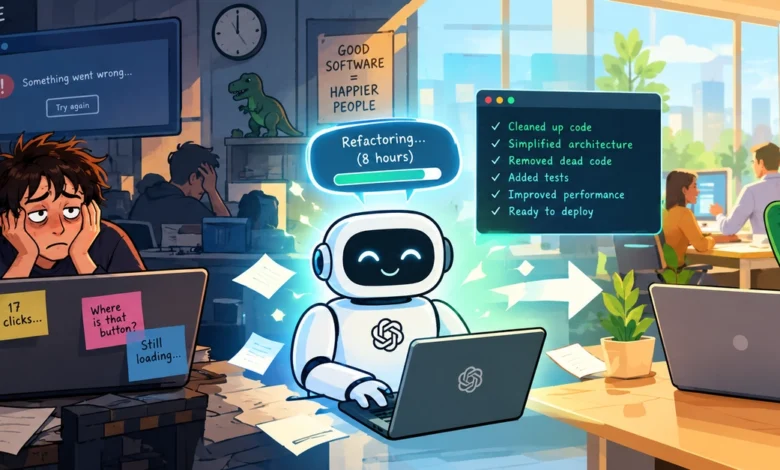
With the advent of advanced coding agents capable of analyzing complex codebases, identifying architectural anti-patterns, writing unit tests, and executing safe migrations, the fundamental economic calculus of code quality is undergoing a radical reassessment. Tasks that previously required an elaborate business case, multi-month project planning, and executive sign-off can now be executed, under human engineering supervision, in significantly compressed timeframes.
Industry analysts and software engineering leaders note that the most profound impact of generative AI will not simply be the raw volume of new code produced—a metric that arguably introduces its own maintenance burdens—but rather the democratization of code quality. By reducing the marginal cost of architectural remediation by an order of magnitude, AI agents remove the traditional friction that prevented organizations from maintaining clean, modern codebases.
Implications for Enterprise Operations and Future Outlook
As the economic barriers to software refactoring dissolve, enterprises are presented with a unique opportunity to address the millions of legacy applications currently anchoring organizational efficiency. When engineering teams can systematically eliminate technical debt without jeopardizing delivery schedules, the default corporate assumption that legacy software must remain permanently flawed is challenged.
This operational evolution promises broader organizational benefits:
- Enhanced Productivity: Employees spend less cognitive energy bypassing system limitations and more time executing primary business objectives.
- Improved Retention: Reducing daily workplace friction directly correlates with higher employee engagement and lower burnout rates within administrative and technical departments.
- Agility in Operations: Modernized codebases enable enterprises to respond to shifting market dynamics with greater speed and structural resilience.
Ultimately, the proliferation of AI coding agents signals a potential turning point in enterprise technology management. By making software quality economically viable even within cost-conscious non-tech enterprises, the industry may finally bridge the long-standing gap between functional necessity and user-centric design, transforming internal enterprise systems from a daily operational burden into genuine competitive assets.