Forrester Study Unveils Staggering 331% ROI for Microsoft Azure Databricks, Demonstrating Tangible Business Value

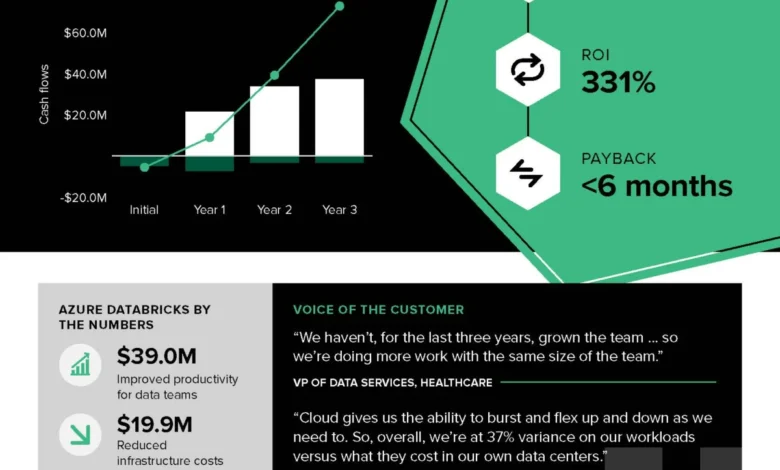
Microsoft Azure Databricks, the native integration of the Databricks Lakehouse Platform within the Microsoft Azure cloud ecosystem, is delivering unprecedented value to organizations, according to a comprehensive Total Economic Impact™ (TEI) study commissioned by Microsoft and conducted by Forrester Consulting. The report, released in June 2026, quantifies the significant financial and operational benefits realized by a composite organization leveraging Azure Databricks, revealing a remarkable three-year return on investment (ROI) of 331%, a net present value (NPV) of $58.1 million, and an investment payback period of less than six months.
The study, which interviewed actual Azure Databricks customers, sought to move beyond technical specifications and address the critical question of tangible business value for decision-makers. The findings underscore the strategic advantage of Azure Databricks as a first-party service, co-engineered by Microsoft and Databricks, offering deep integration with the broader Microsoft data and AI stack. This native integration streamlines workflows, reduces complexity, and ultimately drives down costs while accelerating time-to-value.
The Core Advantage: Native Integration and Co-Engineering
The inherent strength of Azure Databricks lies in its design as a seamless extension of the Azure cloud. Unlike solutions that may require significant integration efforts, Azure Databricks is built from the ground up to function harmoniously with existing Microsoft tools, identity management systems (like Azure Active Directory), and governance frameworks. This "built-in, not bolted-on" approach means that organizations can leverage their established Microsoft infrastructure without the friction and added expense often associated with third-party integrations.
The co-engineering partnership between Microsoft and Databricks ensures a unified product roadmap and a shared vision for the evolution of the data and AI landscape. This alignment translates into a single go-to-market strategy, a consolidated billing process, and a unified support experience for customers. For technical teams, this translates to deeper, more robust integrations and enhanced performance. For the business, the benefits are equally compelling: reduced costs, mitigated risk, and a significantly faster path to realizing the value of their data investments.
Forrester’s Deep Dive: Quantifying the Economic Impact
The Forrester TEI study modeled a composite organization, a $6 billion company operating within a regulated industry and managing approximately 10 petabytes of data. This profile was representative of the interviewed customers and designed to reflect common challenges and opportunities in large-scale data management.
Prior to adopting Azure Databricks, this composite organization faced a fragmented and costly data estate. Their existing infrastructure was characterized by unreliability at scale and significant governance challenges. The implementation of Azure Databricks transformed this landscape, yielding substantial benefits. Over a three-year period, the study projected total benefits of $75.6 million, offset by total costs of $17.5 million, resulting in the impressive $58.1 million in net present value. The swift payback period of less than six months indicates that the initial investment was recouped remarkably quickly, allowing the organization to begin realizing pure profit from its data initiatives shortly thereafter.
The study identified four primary areas where this substantial value was generated:
- Increased Developer Productivity: By providing a unified platform for data engineering, data science, and machine learning, Azure Databricks significantly streamlines workflows. Pre-built connectors, managed infrastructure, and collaborative tools empower teams to develop and deploy data-driven solutions more rapidly. The elimination of manual data wrangling and infrastructure management frees up valuable developer time, allowing them to focus on higher-value tasks.
- Reduced Infrastructure Costs: The native integration with Azure services and the optimized architecture of Azure Databricks contribute to considerable infrastructure savings. Customers benefit from the elasticity and cost-efficiency of the Azure cloud, coupled with Databricks’ optimized processing engine. This avoids the need for redundant data copies, separate tooling stacks, and extensive integration efforts that drive up operational expenses in less integrated environments.
- Enhanced Business Agility and Faster Time to Market: The ability to quickly ingest, process, and analyze vast datasets empowers organizations to respond more nimbly to market changes and customer demands. Faster insights lead to more informed decision-making, enabling the rapid development and deployment of new data products and services. This agility is crucial in today’s competitive business landscape.
- Improved Data Governance and Security: The integration of Databricks’ Unity Catalog with Azure’s robust security and governance features provides a comprehensive framework for managing data access and ensuring compliance. This centralized approach to governance not only mitigates risk but also fosters broader trust and accessibility of data across the organization, enabling more teams to leverage data responsibly.
Beyond these quantifiable benefits, Forrester also highlighted several unquantified but critical advantages. These include the seamless integration with native Azure services, leading to faster insight generation, broader data accessibility for a wider range of users, and enhanced governance capabilities through Unity Catalog. These qualitative benefits are foundational to the quantitative returns, creating a virtuous cycle of innovation and efficiency.
The Evolution of Data Interaction: Genie and Copilot Integration
A key driver of enhanced productivity and value is the increasingly sophisticated integration of Azure Databricks with Microsoft’s productivity tools. The Azure Databricks Genie integration with Microsoft Copilot Cowork represents a paradigm shift in how users interact with data. This integration allows users to embed business context and leverage AI-powered intelligence directly within the tools they use daily, such as Microsoft Teams and Microsoft 365 Copilot.
Genie enables any user, regardless of their technical expertise, to query the lakehouse using natural language. This democratizes access to data, empowering business analysts, marketers, and other non-technical roles to derive insights without relying on specialized data teams. The recent expansion into Copilot Cowork, where tasks are grounded in trusted data through Genie Ontology, further solidifies this accessibility. Crucially, every answer is scoped by Unity Catalog, ensuring that users only see data they are permitted to access, thereby maintaining stringent governance even as data accessibility widens. This seamless flow of intelligence into the workflow without compromising security is a testament to the deep integration achieved.
The platform’s extensibility extends to a wide array of other Azure services, including:
- Azure Synapse Analytics: For unified data warehousing and big data analytics.
- Azure Data Factory: For orchestrating and automating data movement and transformation.
- Azure Machine Learning: For building, training, and deploying machine learning models.
- Power BI: For interactive data visualization and business intelligence reporting.
- Azure Kubernetes Service (AKS): For deploying and managing containerized applications.
- Azure Active Directory: For seamless identity and access management.
These integrations are not merely additive; they are synergistic, creating a cohesive and powerful data and AI ecosystem. While Forrester may not have priced each of these integrations individually, their collective impact on productivity and cost savings is a significant factor in the quantified benefits.
Performance Benchmarks: Speed and Efficiency Verified
Beyond economic value, the performance of Azure Databricks has also been independently validated. Principled Technologies, a respected independent research firm, conducted a rigorous decision-support benchmark, similar to the industry-standard TPC-DS, on a 10-terabyte dataset. The results demonstrated a clear performance advantage for Azure Databricks over its competitor on AWS.
In single-query stream execution, Azure Databricks completed queries up to 21.1% faster than Databricks on AWS (when autoscale was disabled). Furthermore, when running four concurrent query streams, Azure Databricks outperformed the AWS-based solution by more than nine minutes. These benchmarks highlight the efficiency and speed of Azure Databricks, which are critical for maintaining performance as data volumes and user concurrency increase, directly contributing to sustained productivity and cost benefits.
Implications for Organizations: A Strategic Data Foundation
The implications of the Forrester TEI study are profound for organizations considering their data and AI platform strategy. Choosing a data and AI platform is a long-term decision, and Azure Databricks offers a cohesive and reinforcing set of capabilities. The deep integration drives the cost savings identified by Forrester, while the robust performance ensures that these gains are sustained and scalable as usage grows.
At its core, Azure Databricks is built on a foundational partnership that places the engineering expertise, strategic roadmaps, and support capabilities of both Microsoft and Databricks behind an organization’s data estate. This first-party commitment mitigates the risks often associated with fragmented or less integrated solutions. The measured value – a 331% ROI with a payback period under six months – is not merely a marketing claim but a statistically validated outcome, explaining the widespread adoption of Azure Databricks for lakehouse initiatives.
Exploring Further: Resources for Deeper Understanding
For organizations seeking to understand the practical applications and potential impact of Azure Databricks, several resources are available:
- The full Forrester Total Economic Impact™ study: This provides an in-depth analysis of the methodology, findings, and detailed financial projections.
- Azure Databricks product page: Offers comprehensive information on features, capabilities, and pricing.
- Azure Databricks documentation and tutorials: Provides technical guidance for implementation and development.
- Microsoft Learn modules on Azure Databricks: Offers structured learning paths for individuals and teams.
- Case studies and customer testimonials: Showcases real-world success stories and practical use cases.
- Information on Azure Databricks integrations: Details how the platform connects with other Azure services and Microsoft productivity tools.
In conclusion, the independent validation from Forrester Consulting solidifies Azure Databricks’ position as a leading platform for organizations looking to unlock the full potential of their data. The combination of native Azure integration, co-engineered innovation, exceptional performance, and demonstrable economic value makes it a compelling choice for driving data-driven transformation and achieving strategic business objectives.