How a Unicode Normalization Bug Quietly Sabotaged an AI Search Index for Months

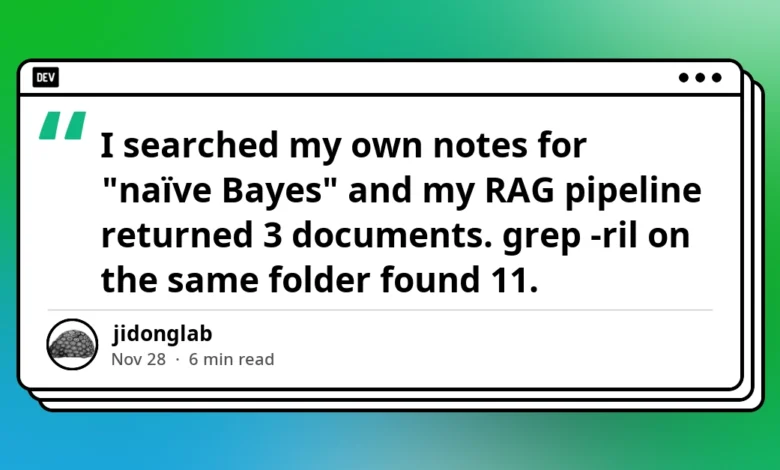
The hidden complexities of character encoding continue to challenge modern software engineering, recently culminating in a systemic retrieval failure within a production Retrieval-Augmented Generation (RAG) pipeline. When an engineer searched personal notes for the term "naive Bayes," the system returned a meager three documents, whereas a traditional system-level grep utility located eleven. The investigation that followed revealed a subtle yet pervasive data integrity flaw driven by Unicode normalization discrepancies, exposing vulnerabilities that can quietly undermine enterprise search quality, tokenization integrity, and deduplication mechanisms.
Background Context and Technical Anatomy of Unicode Normalization
At the core of the incident lies the dual nature of the Unicode standard, which often permits multiple distinct byte sequences to render as the identical visual glyph on a user screen. This structural flexibility is managed through Unicode normalization forms, primarily Normalization Form C (NFC) and Normalization Form D (NFD).
In NFC, characters are represented in a precomposed form wherever possible. For example, the accented character "é" exists as a single code point. Conversely, NFD decomposes characters into their constituent base letters and combining diacritical marks—meaning "é" becomes the base letter "e" combined with a separate acute accent code point.
While operating systems, graphical user interfaces, and large language model chat interfaces render both representations identically, backend software layers view them as fundamentally distinct. String equality comparisons (a == b), cryptographic hashing algorithms like SHA-256, relational database WHERE clauses, and regex-based tokenizers treat NFD and NFC sequences as entirely unrelated entities. Consequently, unnormalized corpora suffer from fractured indexing, where identical concepts fail to coalesce during data ingestion.
Chronology of the Discovery and Ingestion Vulnerabilities
The investigation traced the corrupted text back to two primary ingestion vectors: automated PDF document processing and legacy filesystem backups.
Approximately 400 documents within the 2,870-file corpus originated as PDFs or vendor whitepapers. Depending on the software used to generate these files, text extraction utilities routinely output accented characters in decomposed NFD format. Furthermore, these extraction tools frequently preserved typographic ligatures—such as converting the word "configuration" into a single code point ligature (U+FB01) for "fi"—rendering the terms entirely opaque to standard keyboard queries.
The second vector stemmed from historical macOS backups utilizing the Hierarchical File System Plus (HFS+) standard, which natively stored filenames in decomposed NFD format. Because the pipeline’s ingestion script prepended filenames as title headers to each document chunk, files originating from older backups injected NFD characters directly into the headers while the document bodies, generated on modern APFS machines, remained in NFC. This created a volatile condition of mixed normalization within single text chunks.
Measuring the Damage: Audit Methodology and Empirical Findings
To quantify the systemic impact, the developer constructed a diagnostic audit script leveraging Python’s built-in unicodedata standard library module. Scanning the entire database of 41,200 distinct text chunks revealed startling metrics regarding corpus health.
| Audit Metric | Total Count | Percentage of Corpus |
|---|---|---|
| Total Chunks Indexed | 41,200 | 100% |
| Chunks Failing NFC Verification | 3,914 | 9.5% |
| Chunks Containing Latin Ligatures | 1,106 | 2.7% |
| Byte-Different but NFC-Equivalent Chunks | 612 | 1.5% |
The discovery of 612 byte-different duplicates highlighted a severe deduplication failure. Because the pipeline relied on cryptographic text hashing to identify redundancy, paragraphs ingested once from a PDF and once from personal notes generated divergent hashes despite identical human-readable content. Both versions were stored in the vector database, polluting retrieval results, consuming valuable context windows in downstream large language models, and displacing more relevant knowledge sources.
Concurrently, the BM25 keyword search component relied on standard regular expression tokenizers (re.findall(r"w+", text)). Because regex word boundaries treat combining marks as non-alphanumeric characters, NFD-encoded words like "naive" were fragmented during tokenization into isolated components (e.g., splitting into "nai" and "ve"). Hybrid search architectures failed to compensate, as dense vector models occasionally prioritized duplicate unnormalized entries over correct source documents, compounding the recall deficit.
Implementation of the Remediation Strategy
Resolving the architectural flaw required enforcing strict boundary normalization. The development team implemented a two-tier cleaning pipeline designed to sanitize incoming documents and queries prior to processing:
import unicodedata

_LIGATURE_MAP = str.maketrans(
    "ff": "ff", "fi": "fi", "fl": "fl",
    "ffi": "ffi", "ffl": "ffl", "ſt": "st", "st": "st",
)

def clean(text: str) -> str:
    return unicodedata.normalize("NFC", text).translate(_LIGATURE_MAP)

def search_key(text: str) -> str:
    # Dedicated exclusively to BM25 tokens and deduplication hashes
    return unicodedata.normalize("NFKC", clean(text)).casefold()
Under this protocol, the clean() function executes universally prior to chunking, hashing, embedding, and storage, ensuring that the stored text and model context remain pristine NFC. Meanwhile, search_key() is restricted solely to auxiliary search structures like BM25 indices and deduplication hashes, incorporating Normalization Form KC (NFKC) compatibility folding alongside case folding.
The team bypassed full re-indexing of the 41,200-chunk database, instead targeting the 3,914 non-NFC chunks and 612 duplicates for localized re-embedding.
Secondary Complications and Architectural Implications
The transition exposed secondary maintenance challenges, most notably within user interface highlighting systems. Because normalization alters string byte lengths and code point counts, character offsets calculated prior to normalization drifted leftward upon re-ingestion, breaking user-interface text highlighting and citation anchors. Consequently, the team abandoned static offset storage in favor of dynamic runtime span matching against stored NFC text.
Post-remediation benchmarks confirmed a dramatic recovery in retrieval accuracy. Non-ASCII query recall rose from an initial baseline of 35 successful retrievals out of 60 test queries to near-complete recovery, eliminating ghost duplicates and optimizing context window utilization for large language models.
Industry analysts note that character encoding vulnerabilities remain an underappreciated risk in enterprise artificial intelligence deployments. As organizations rapidly scale unstructured data ingestion from diverse legacy repositories, unmonitored normalization drift can silently degrade retrieval performance, reinforcing the necessity of rigorous boundary sanitization in modern data engineering pipelines.