Submillimeter Array Revolutionizes Transient Astronomy with Rapid Response Milestone for Gamma Ray Bursts

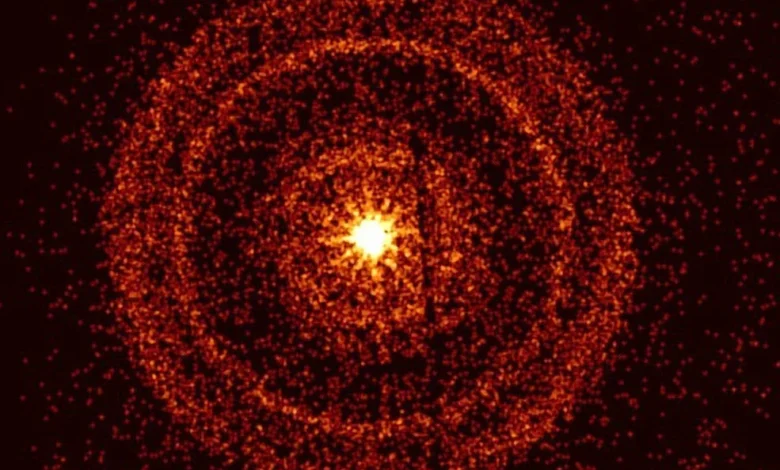
On January 26, 2026, the Submillimeter Array (SMA), an eight-telescope radio interferometer situated near the 4,200-meter summit of Maunakea in Hawaii, achieved a landmark success in the field of time-domain astronomy. This event marked the first time a ground-based millimeter-wave observatory successfully demonstrated a fully automated, rapid-response capability to capture the immediate afterglow of a gamma-ray burst (GRB). By reacting within minutes to a cosmic eruption detected by orbiting space telescopes, the SMA has bridged a significant gap in multi-wavelength observations, allowing scientists to probe the mechanics of the universe’s most violent explosions with unprecedented speed and precision.
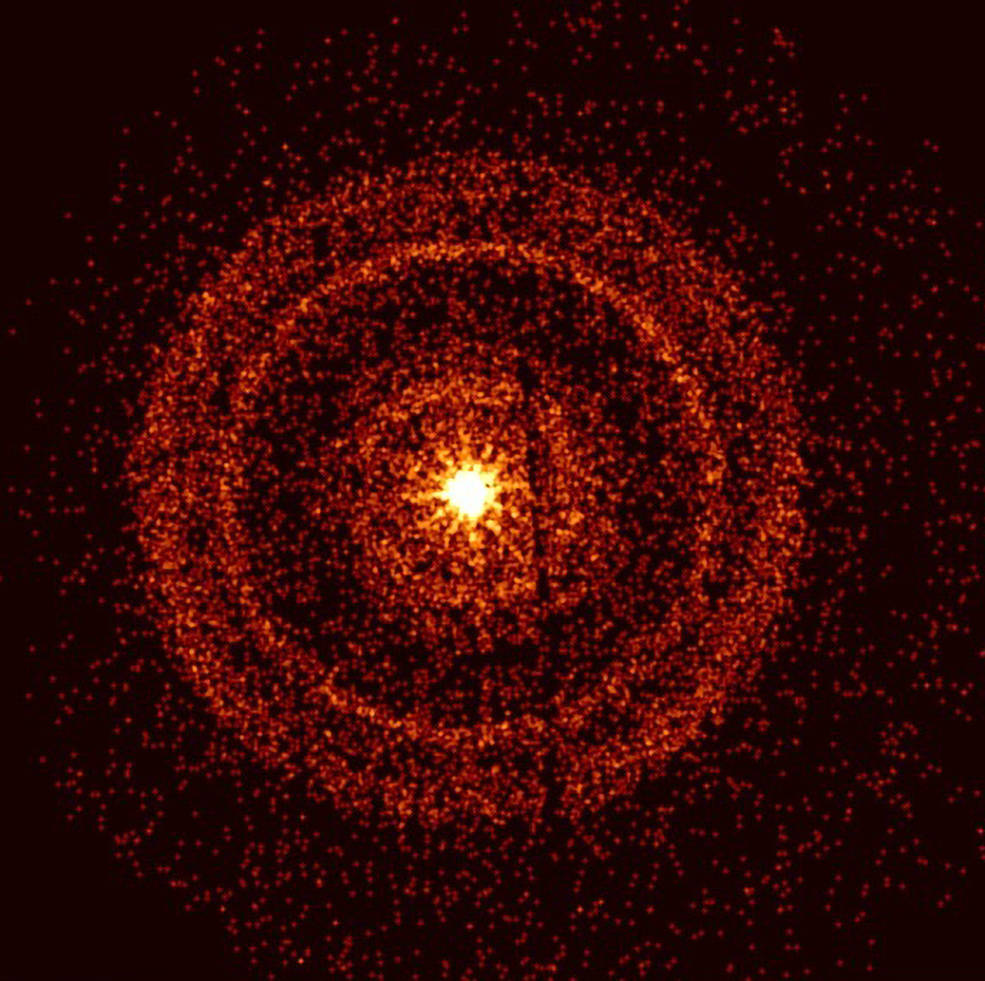
The demonstration began when NASA’s Neil Gehrels Swift Observatory, a space-based facility designed specifically to detect transient high-energy events, identified a sudden flash of gamma rays emanating from a source approximately 1.8 billion light-years from Earth. The detection triggered an automated alert that was transmitted through the General Coordinates Network (GCN). Within a mere 90 seconds of the initial detection, the SMA’s new alert system notified the on-duty operator at the Harvard & Smithsonian Center for Astrophysics (CfA). In less than 13 minutes, the eight parabolic dishes of the SMA were slewed to the target coordinates, and an automated analysis pipeline began generating images of the explosion in near real-time.
The Evolution of Rapid Response in Radio Astronomy
Historically, observing the immediate aftermath of a gamma-ray burst in the millimeter and submillimeter wavelengths has been a logistical and technical challenge. While X-ray and optical telescopes—such as those on the Swift satellite itself or robotic ground-based optical arrays—have been able to pivot and begin observations within seconds, radio and millimeter-scale interferometers have traditionally lagged. These systems often require complex manual intervention, calibration, and data processing that can take hours or even days to finalize.
The SMA’s achievement represents a departure from this traditional model. The new system, known as the SMA Sub/millimeter Program to Rapidly Investigate Novel Time-domain Sources (SMA SPRINTS), utilizes the wideband upgrade (wSMA) to automate the entire chain of observation. This includes the reception of the alert, the reprioritization of telescope scheduling, the mechanical slewing of the antennas, and the immediate processing of interferometric data. This leap in capability is roughly two orders of magnitude faster than previous standards for millimeter telescopes, transforming a process that once took a full day into one that occurs during a short coffee break.
The speed of this response is not merely a technical curiosity; it is a scientific necessity. Gamma-ray bursts are the most powerful outbursts in the known universe, releasing more energy in a few seconds than the Sun will emit over its entire 10-billion-year lifetime. These events are produced by relativistic jets—narrow streams of plasma and charged particles traveling at nearly the speed of light. These jets are typically launched during the catastrophic collapse of a massive star (a supernova) or the violent merger of two compact objects, such as neutron stars (a kilonova).
The Physics of Shocks and Afterglows
To understand why 13 minutes is a critical threshold, one must look at the physics of the GRB afterglow. When the relativistic jet is launched, it plows into the surrounding interstellar medium. This interaction creates two distinct types of shocks: a forward shock (FS) that moves outward into the local environment, and a reverse shock (RS) that propagates backward into the material ejected by the explosion.
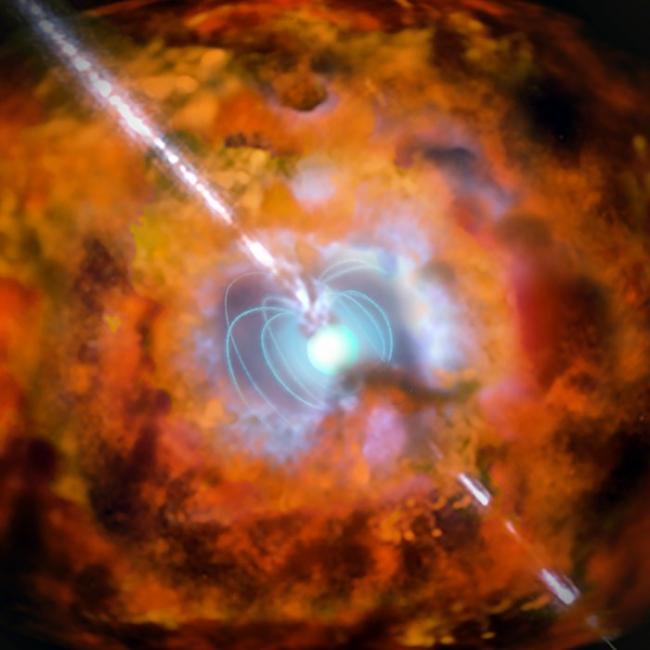
The forward shock is responsible for the long-lasting afterglow seen in X-ray and optical frequencies. However, the forward shock’s emission is primarily sensitive to the total energy of the explosion and the density of the surrounding gas. To understand the "engine" of the explosion itself—the jet’s composition, its degree of magnetization, and its internal structure—astronomers must observe the reverse shock.
Reverse shocks are incredibly fleeting, often peaking and fading within minutes to hours of the initial burst. Because millimeter and submillimeter waves are particularly sensitive to the emission from these reverse shocks, capturing them requires the kind of rapid-response system demonstrated by the SMA. By observing the source just 13 minutes after the flash, the CfA team was able to capture data that would have been lost if they had waited for traditional scheduling. Follow-up observations conducted two days later confirmed that the source had significantly faded, proving that the SMA had indeed captured the transient afterglow rather than a stable background source.
Technical Specifications and the Role of Maunakea
The Submillimeter Array’s location on Maunakea is pivotal to its success. Submillimeter astronomy requires an extremely dry atmosphere because water vapor in Earth’s air absorbs the high-frequency radio waves coming from space. At an elevation of 13,800 feet, the SMA sits above much of the atmospheric moisture, providing a clear window into the "cool" universe.
The array consists of eight movable antennas, each 6 meters in diameter. By combining the signals from these antennas using a technique called interferometry, the SMA acts as a single, much larger telescope, capable of resolving fine details in distant cosmic structures. The recent wSMA upgrade has expanded the bandwidth of the array, allowing it to collect more data across a wider range of frequencies simultaneously. This increased sensitivity is what allows the SPRINTS program to detect the relatively faint signals of a GRB afterglow against the noise of the cosmos.
Expert Reactions and Collaborative Efforts
The success of the January 26th observation has drawn praise from the international astrophysical community. Garrett Keating, the Deputy Director of the SMA and leader of the rapid-response initiative at the CfA, emphasized the transformative nature of the new system. According to Keating, the ability to process data in real-time is a fundamental shift for the observatory. He noted that while the 13-minute response was a major milestone, the team is already looking to optimize the software and hardware to reduce that time to just two or three minutes.
Co-author Tanmoy Laskar, an Assistant Professor of Physics and Astronomy at the University of Utah, highlighted the scientific potential of the wSMA. Laskar pointed out that this capability provides a unique window into the physics of stellar explosions. By probing the ejecta in such detail, researchers can begin to answer fundamental questions about how these jets are launched and what role magnetic fields play in collimating the energy of a collapsing star.
The project is a collaborative effort involving various institutions, reflecting the multi-disciplinary nature of modern astronomy. The data collected by the SMA is often cross-referenced with data from other facilities, such as the Atacama Large Millimeter/submillimeter Array (ALMA) in Chile or the Very Large Array (VLA) in New Mexico, to create a comprehensive picture of the event across the electromagnetic spectrum.
Broader Implications for the Future of Astronomy
The timing of this breakthrough is particularly significant as the global astronomical community prepares for a new era of "big data" surveys. Facilities currently under construction or in early operation, such as the Vera C. Rubin Observatory in Chile and the Nancy Roman Space Telescope, are expected to revolutionize the field of time-domain astronomy.
The Rubin Observatory, equipped with the Legacy Survey of Space and Time (LSST), will scan the entire visible sky every few nights. It is predicted to generate millions of automated alerts every 24 hours, identifying everything from passing asteroids to distant supernovae and GRBs. For radio and millimeter observatories to remain relevant in this environment, they must be able to handle a high volume of triggers and respond with the same speed as the SMA SPRINTS program.
The SMA’s success serves as a blueprint for how older, established observatories can be upgraded with modern software and wideband electronics to meet the demands of the 21st century. It moves the field away from "static" astronomy—where telescopes look at fixed objects for long periods—and toward a "dynamic" model where the universe is monitored as a living, changing entity.
Conclusion and Next Steps
The demonstration on January 26, 2026, is just the beginning for the SMA SPRINTS program. As the system moves from the "proof of concept" phase into full scientific operation, it will likely become a primary tool for studying not only gamma-ray bursts but also other transient phenomena such as fast radio bursts (FRBs), tidal disruption events (where a star is torn apart by a black hole), and the electromagnetic counterparts to gravitational wave events.
By narrowing the gap between the detection of a cosmic event and its observation at millimeter wavelengths, the Harvard & Smithsonian Center for Astrophysics has provided the scientific community with a new set of eyes. These eyes are capable of seeing through the dust and gas of the universe to the very heart of its most energetic explosions, offering a clearer understanding of the life and death of stars and the fundamental laws of physics that govern the cosmos. With the goal of a three-minute response time on the horizon, the SMA is poised to ensure that when the next great cosmic eruption occurs, humanity will be ready to watch it unfold in real-time.