Hubble Observations Reveal First Known Comet to Undergo Spin Reversal During Perihelion Passage

The field of cometary science has reached a significant milestone with the identification of the first comet known to have completely reversed its rotational direction. Researchers at the University of California, Los Angeles (UCLA), utilizing high-resolution data from NASA’s Hubble Space Telescope, have confirmed that the comet 41P/Tuttle-Giacobini-Kresák—frequently referred to as 41P—exhibited this unprecedented behavior during its 2017 approach to the Sun. This discovery, published in The Astronomical Journal, provides a rare window into the volatile physical dynamics that govern the life and eventual death of these ancient celestial bodies.
Comets are often described as "dirty snowballs," composed of frozen gases, rocks, and dust dating back to the formation of the solar system approximately 4.6 billion years ago. While they are celebrated by the public for the spectacular tails they develop when nearing the Sun, for astronomers, they represent pristine time capsules. The discovery of 41P’s reverse spin suggests that the physical evolution of these bodies can be far more erratic and rapid than previously theorized, with outgassing events serving as powerful engines of mechanical change.
The Mechanics of Rotational Reversal
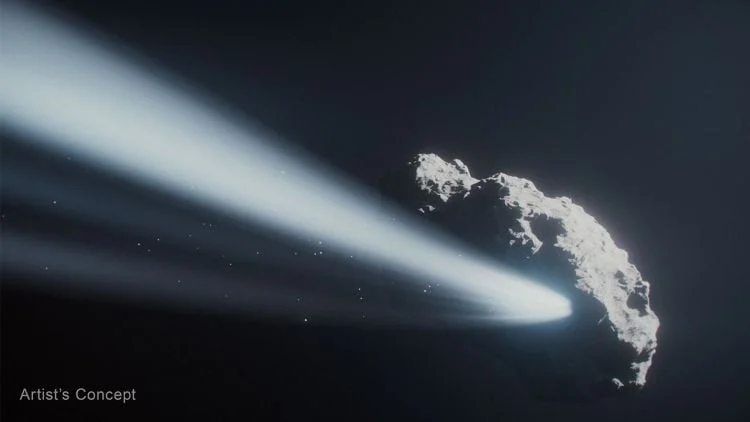
The study, authored by Dr. David Jewitt, a Distinguished Professor in the Department of Earth, Planetary, and Space Sciences at UCLA, posits that the reversal is driven by the comet’s own internal activity. As a comet approaches the Sun, its icy core, or nucleus, begins to heat up. This causes the ice to sublimate—turning directly from a solid into a gas. This gas, along with trapped dust, escapes from the nucleus in the form of high-velocity jets.
Dr. Jewitt explains that these jets of gas function similarly to thrusters on a spacecraft. If these jets are distributed unevenly across the surface of the nucleus, they exert a torque on the body. "Jets of gas streaming off the surface can act like small thrusters," Dr. Jewitt stated. "If those jets are unevenly distributed, they can dramatically change how a comet, especially a small one, rotates. It’s like pushing a merry-go-round. If it’s turning in one direction, and then you push against that, you can slow it and reverse it."
In the case of 41P, the Hubble data suggests that the torque generated by these outgassing jets was so significant that it caused the comet’s rotation to decelerate to a complete stop before beginning to spin in the opposite direction. This phenomenon, while theoretically possible in orbital mechanics, had never been observed in a cometary body until now.
A Chronological Perspective on 41P/Tuttle-Giacobini-Kresák
The history of 41P is as erratic as its rotation. The comet is named after the three astronomers who discovered it independently over nearly a century. It was first spotted by Horace Parnell Tuttle in 1858, but its orbit was not well-defined, and the comet was "lost" for decades. It was rediscovered by Michel Giacobini in 1907 and again by Luboš Kresák in 1951. This "triple discovery" is a testament to the comet’s unpredictable brightness and its tendency to undergo massive outbursts of activity.
The 2017 perihelion—the point in its orbit where it is closest to the Sun—offered a unique opportunity for Hubble to observe the comet with extreme precision. However, these observations revealed a startling contrast to previous visits. When compared to data from its 2001 perihelion, 41P appeared significantly less active in 2017. Typically, changes in a comet’s surface activity are expected to occur over centuries or millennia as the body slowly loses its volatile materials. The fact that 41P underwent such a dramatic shift in just 25 years suggests a highly unstable internal structure or a rapidly depleting reservoir of surface ice.
Physical Characteristics and Structural Vulnerability
Hubble estimates indicate that the nucleus of 41P is relatively small, measuring approximately 1 kilometer (0.6 miles) in diameter. For a body of this size, the forces generated by outgassing are disproportionately influential. The study suggests two primary possibilities for 41P’s unique behavior: either the comet is emitting an unusually large volume of gas relative to its mass, or it is a fragment that broke off from a much larger parent comet in the distant past.
The rotational instability observed in 2017 carries dire implications for the comet’s longevity. Computer models used in the UCLA study indicate that at its current spin rate and trajectory, 41P is experiencing extreme centripetal forces. If the spin continues to accelerate or if the structural integrity of the nucleus is compromised by further outgassing, the comet is hypothesized to eventually rip itself apart.
While the average lifespan of a short-period comet is roughly 1,000 years once it enters the inner solar system, the study estimates that 41P’s nucleus may only last another few decades. This rapid disintegration would make 41P one of the fastest-decaying comets currently under observation.
The Role of the Kuiper Belt and Oort Cloud
Understanding the origin of 41P is crucial for contextualizing its behavior. 41P is classified as a short-period comet, originating from the Kuiper Belt—a vast region of icy objects extending from the orbit of Neptune (about 30 AU) to approximately 50 AU from the Sun. These comets are frequently nudged by the gravity of the giant planets, particularly Jupiter, into the inner solar system. 41P completes an orbit every 5.4 years, placing it in the "Jupiter-family" of comets.
The Kuiper Belt is estimated to contain trillions of comets, many of which are remnants of the solar nebula that formed the planets. However, it is not the only source of these bodies. Farther out lies the Oort Cloud, a spherical shell of icy debris that extends up to 100,000 AU from the Sun. While the Kuiper Belt produces short-period comets like 41P, the Oort Cloud is the source of long-period comets, which can take thousands or even millions of years to complete a single orbit.
By studying bodies like 41P, scientists gain insights into the different chemical and physical compositions of these two distinct regions. The fact that 41P is undergoing such rapid physical change suggests that even "stable" Kuiper Belt objects can undergo catastrophic transformations once they are subjected to the thermal stresses of the inner solar system.
Broader Implications for Planetary Science
The discovery of a spin reversal in 41P challenges existing models of cometary evolution. Most models assume a relatively steady, albeit slow, degradation of cometary nuclei. The UCLA findings suggest that "rotational disruption"—the process by which a comet spins so fast it breaks apart—may be a primary driver of cometary death, perhaps even more so than simple evaporation.
Furthermore, this study highlights the critical role of high-resolution space-based observatories. Without the precision of the Hubble Space Telescope, the subtle changes in 41P’s rotation would have likely gone unnoticed, hidden within the bright glare of its coma (the cloud of gas and dust surrounding the nucleus).
The scientific community has reacted to the findings with significant interest. While Dr. Jewitt remains the sole author of this specific study, the broader astronomical community views these results as a call to increase monitoring of small-diameter comets. These smaller bodies are more susceptible to non-gravitational forces—like the "thruster effect" of gas jets—and therefore offer the best opportunities to study the physics of rotational instability.
Analysis: The Future of Cometary Observation
As we look toward the future, the fate of 41P/Tuttle-Giacobini-Kresák serves as a cautionary tale of the volatility inherent in our solar system’s smallest members. The possibility that 41P could disintegrate within the next few decades provides a rare "real-time" opportunity for astronomers to witness the final stages of a comet’s life cycle. Such an event would provide invaluable data on the internal strength and composition of cometary nuclei, information that is vital for future missions aimed at diverting potentially hazardous near-Earth objects.
The study of 41P also underscores the importance of the "why we science" philosophy mentioned by enthusiasts: every anomaly, such as a reverse-spinning snowball, opens a new chapter in our understanding of the universe’s history. As researchers continue to analyze data from Hubble and prepare for new observations from the James Webb Space Telescope and the upcoming Vera C. Rubin Observatory, the mysteries of cometary dynamics will continue to unfold.
For now, 41P remains a unique outlier—a tiny, 1-kilometer relic of the early solar system that is quite literally pushing itself to the brink of destruction. Whether it survives its next few passes around the Sun or succumbs to the forces of its own internal thrusters, it has already secured its place in the annals of astronomy as the first comet to turn back the clock on its own rotation.
Related posts: