Anthropic Elevates Claude’s Voice Mode with Multi-Model Support and Deep App Integrations, Intensifying AI Assistant Race

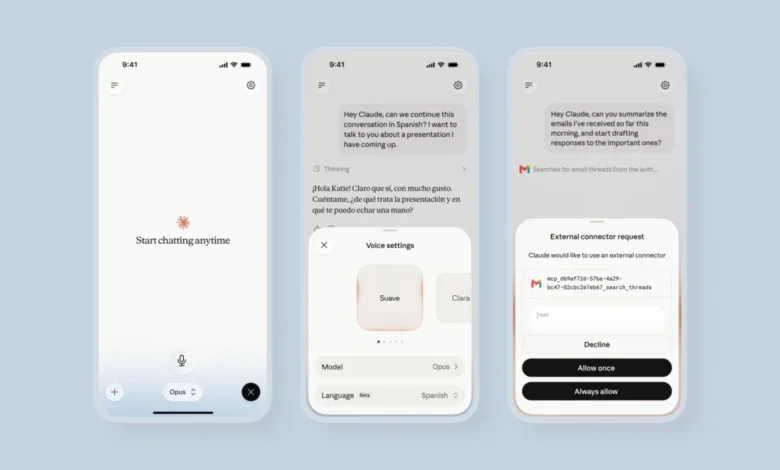
In a significant move that reshapes the competitive landscape of conversational artificial intelligence, Anthropic, a leading AI safety and research company, has unveiled a substantial update to Claude’s voice mode. This enhancement allows users to leverage the full power of its flagship models—Opus, Sonnet, and Haiku—directly through voice, marking a strategic counterpoint to recent advancements by rival OpenAI. The company announced on Thursday that the upgraded voice mode is now available, promising a more versatile and integrated experience for users seeking sophisticated AI assistance beyond mere conversation.
The Evolution of Voice AI and the Competitive Arena
The realm of AI voice assistants has witnessed rapid evolution, transitioning from basic command-and-control systems like early iterations of Siri and Alexa to sophisticated generative AI models capable of nuanced, context-aware dialogue. This technological leap has paved the way for more natural and productive interactions between humans and machines. In this fast-paced environment, companies are in a continuous race to out innovate each other, vying for market share and user preference.
Just weeks prior to Anthropic’s announcement, OpenAI, a major competitor, rolled out its own new family of conversational models and significantly updated ChatGPT’s voice mode. On July 8, 2026, OpenAI introduced features designed to make live conversations with ChatGPT more natural, focusing on improved fluidity, better interruption handling, and more human-like intonation. This move set a new benchmark for conversational AI, putting pressure on other developers to enhance their offerings. Anthropic’s latest update can be seen as a direct response, albeit one that carves out a distinct niche focused on practical utility and deeper integration into user workflows.
Chronology of Voice AI Development at Anthropic
Anthropic first introduced a voice mode for Claude in May 2025. This initial offering, powered exclusively by the faster Haiku model, provided quick responses suitable for straightforward queries. However, it was inherently limited in its capacity to handle complex tasks or engage in extended, intricate discussions. The primary focus at that time was on speed and accessibility, laying the groundwork for more advanced capabilities.
Recognizing the growing demand for more robust AI assistants capable of handling diverse and complex user needs, Anthropic embarked on refining Claude’s voice interface. The current update, released on a recent Thursday in July 2026, represents a significant upgrade, moving beyond the single-model limitation to offer a spectrum of intelligence levels directly through voice. This strategic enhancement follows months of development aimed at integrating the company’s most powerful models and enabling seamless interaction with external applications.
Unlocking Advanced Intelligence: Multi-Model Voice Access

A cornerstone of Anthropic’s new voice mode is the ability for users to select from its trio of state-of-the-art models: Opus, Sonnet, and Haiku. Each model offers a distinct balance of intelligence, speed, and cost, allowing users to tailor Claude’s capabilities to their specific needs.
- Opus: Anthropic’s most powerful and intelligent model, designed for highly complex tasks, deep reasoning, and nuanced understanding. When accessed via voice, Opus can facilitate intricate problem-solving, detailed analysis, and sophisticated strategic discussions, making it ideal for professionals tackling challenging assignments.
- Sonnet: A balanced model offering a strong combination of intelligence and speed, suitable for a wide range of general-purpose tasks. Sonnet in voice mode can provide comprehensive answers, assist with research, and help structure thoughts efficiently without the computational overhead of Opus.
- Haiku: The fastest and most cost-effective model, optimized for quick, straightforward responses. While still available, Haiku is now complemented by its more powerful siblings, making it the go-to for rapid-fire questions and simple interactions.
The update intelligently defaults the voice mode to the last model a user employed in text chat, ensuring continuity in their AI interaction. Furthermore, it automatically utilizes the fastest version of that chosen model, prioritizing efficiency. This dynamic model selection mechanism ensures that whether a user needs quick information or deep analytical support, Claude’s voice interface is ready to deliver. This flexibility significantly broadens the scope of tasks Claude can assist with verbally, from brainstorming intricate product market research strategies and providing real-time feedback on communication styles to talking through a critical client pitch with unparalleled depth.
Bridging the Gap: Deep Integration with Productivity Applications
Perhaps the most impactful differentiator of Anthropic’s updated voice mode is its native ability to tap into and interact with a suite of popular third-party applications. This represents a significant leap beyond traditional conversational AI, transforming Claude into an active digital agent capable of performing real-world tasks. The new voice mode seamlessly integrates with:
- Gmail: Users can verbally instruct Claude to draft emails, summarize threads, or search for specific information within their inbox, streamlining communication workflows.
- Google Calendar: Scheduling and managing appointments becomes effortless, with Claude able to update meeting slots, create new events, or remind users of upcoming commitments based on voice commands.
- Slack: Facilitating team collaboration, Claude can be instructed to post updates, share documents, or retrieve information from channels, all through spoken dialogue.
- Canva: For creative professionals, Claude can assist in brainstorming design concepts, outlining presentations, or even initiating the creation of visual assets within Canva, turning verbal ideas into actionable design prompts.
- Notion: Users can leverage Claude’s voice mode to create new documents, add tasks to existing databases, or organize notes within Notion, enhancing productivity and knowledge management.
This deep integration directly addresses a critical limitation often found in other advanced AI voice modes, including OpenAI’s latest offerings. While OpenAI has focused on refining the naturalness of conversation, Anthropic has prioritized actionability. The ability for Claude to execute tasks across multiple applications positions it as a more comprehensive and proactive assistant, capable of not just understanding user intent but also acting upon it within their existing digital ecosystem. This move underscores a growing trend in AI development towards "agentic AI" – systems that can autonomously perform a sequence of actions to achieve a user’s goal.
Global Reach: Enhanced Multilingual Support
Further expanding its utility, Anthropic has enhanced Claude’s multilingual capabilities in its voice mode, which was initially introduced in beta earlier this year. Users can now engage with Claude in a variety of languages, reflecting Anthropic’s commitment to global accessibility. The currently supported languages include English, French, German, Hindi, Indonesian, Italian, Japanese, Korean, Portuguese (Brazilian), and Spanish (Latin America/Spain). While users still need to manually specify the language they wish to speak in, this feature significantly broadens Claude’s appeal and usefulness to a diverse international user base. The manual specification is a minor friction point that future iterations will likely address with automatic language detection, further enhancing the seamlessness of interaction.
Accessibility and Monetization Strategy
The new voice mode is currently available to all users in beta across various platforms, indicating a broad rollout strategy. However, Anthropic has implemented a tiered access model, particularly for its free users. Free users will be restricted to utilizing the Haiku model, known for its speed and efficiency, and will be limited to connecting with only one external application. This strategic limitation serves as an incentive for users to explore Anthropic’s premium offerings, which unlock the full potential of Opus and Sonnet models and provide unlimited app integrations, thus encouraging subscriptions and broader adoption of its advanced capabilities.

A Divergent Path: Anthropic’s Focus vs. OpenAI’s Approach
A crucial point of distinction between Anthropic’s latest release and OpenAI’s recent updates lies in their respective focus areas. While OpenAI concentrated on refining the underlying voice model to achieve more natural conversational dynamics, including improved interruption handling and emotional nuance, Anthropic’s update primarily enhances the utility and intelligence of its voice mode by integrating its powerful language models and enabling app interactions.
Anthropic explicitly stated that no changes were made to the core voice model itself with this release, nor has it detailed its specific voice stack. This suggests that while users will benefit from superior intelligence and task execution, they might not immediately perceive improvements in the pure conversational flow, such as more seamless turn-taking or more human-like responses, aspects that OpenAI has heavily invested in. This divergence highlights two distinct philosophies in the development of AI assistants: one prioritizing the naturalness of interaction, and the other emphasizing functional capability and integration into daily workflows. Both approaches are valid and cater to different user needs, but Anthropic’s strategy of deep app integration potentially offers a more immediate and tangible impact on productivity for many professional users.
Broader Impact and Implications for the AI Ecosystem
Anthropic’s strategic pivot towards deeply integrated, multi-model voice assistance carries significant implications for the broader AI ecosystem:
- Intensified Competition: This update escalates the competitive "arms race" in the AI assistant market. As companies like Anthropic, OpenAI, Google, and Meta continue to push the boundaries, users will benefit from increasingly sophisticated and versatile AI tools. The differentiator will increasingly lie not just in raw intelligence but in how seamlessly AI can integrate into and augment human workflows.
- The Rise of Agentic AI: Anthropic’s app integrations represent a clear step towards "agentic AI"—AI systems that can not only understand but also act on behalf of the user across different platforms. This paradigm shift moves AI from being a mere information provider to a proactive digital assistant, capable of automating complex sequences of tasks. This has profound implications for productivity in both personal and professional spheres.
- Transforming the Future of Work: The ability of AI assistants to manage calendars, draft communications, and organize information through natural language will fundamentally alter how individuals and teams operate. Routine administrative tasks could be significantly streamlined, freeing up human workers to focus on more creative, strategic, and complex problem-solving. This could lead to substantial gains in efficiency across industries.
- User Experience Evolution: User expectations for AI will continue to evolve. They will no longer be satisfied with simple query-response interactions but will demand AI that can proactively anticipate needs, execute tasks, and integrate seamlessly into their digital lives. Anthropic’s update directly addresses this evolving demand.
- Data Privacy and Security Considerations: As AI gains access to more personal and professional data across various applications, robust data privacy and security protocols become paramount. Anthropic, known for its focus on AI safety, will need to continually ensure that its integrations uphold the highest standards of data protection, especially for enterprise users. The responsible deployment of such powerful, integrated AI is a critical challenge for the industry.
- Market Segmentation: The distinct approaches taken by Anthropic and OpenAI might lead to a natural market segmentation. Users prioritizing deep utility and task automation might gravitate towards Claude, while those valuing the most natural and human-like conversational experience might prefer ChatGPT. Over time, these capabilities may converge, but for now, distinct competitive advantages are being forged.
Conclusion
Anthropic’s latest update to Claude’s voice mode is more than just an incremental improvement; it’s a strategic declaration in the ongoing race for AI supremacy. By empowering users with a choice of powerful models via voice and, more crucially, by enabling deep, actionable integrations with key productivity applications, Anthropic has positioned Claude as a highly capable, task-oriented digital agent. This move not only intensifies competition with rivals like OpenAI but also signals a significant shift in the trajectory of AI development towards more integrated, proactive, and functionally rich AI assistants that promise to redefine human-computer interaction and reshape the future of work. As the beta rollout progresses, the industry will closely watch how users leverage these new capabilities and how Anthropic continues to evolve its offerings in this dynamic and rapidly expanding market.
Related posts: