Amazon S3 is now available on the Vercel Marketplace and v0 by Vercel | Amazon Web Services

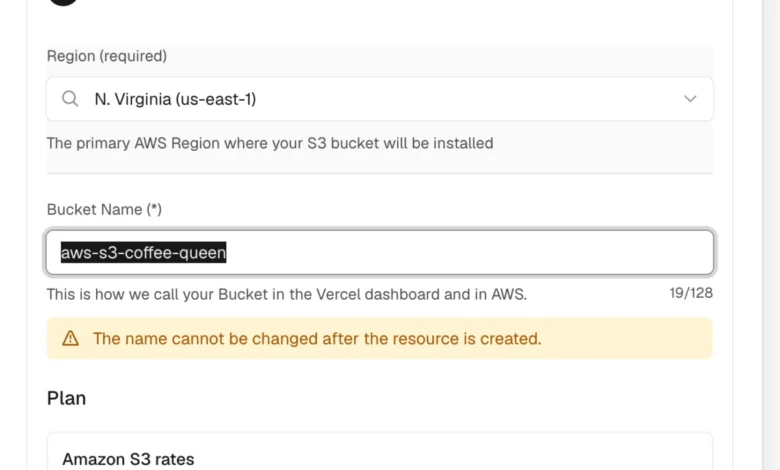
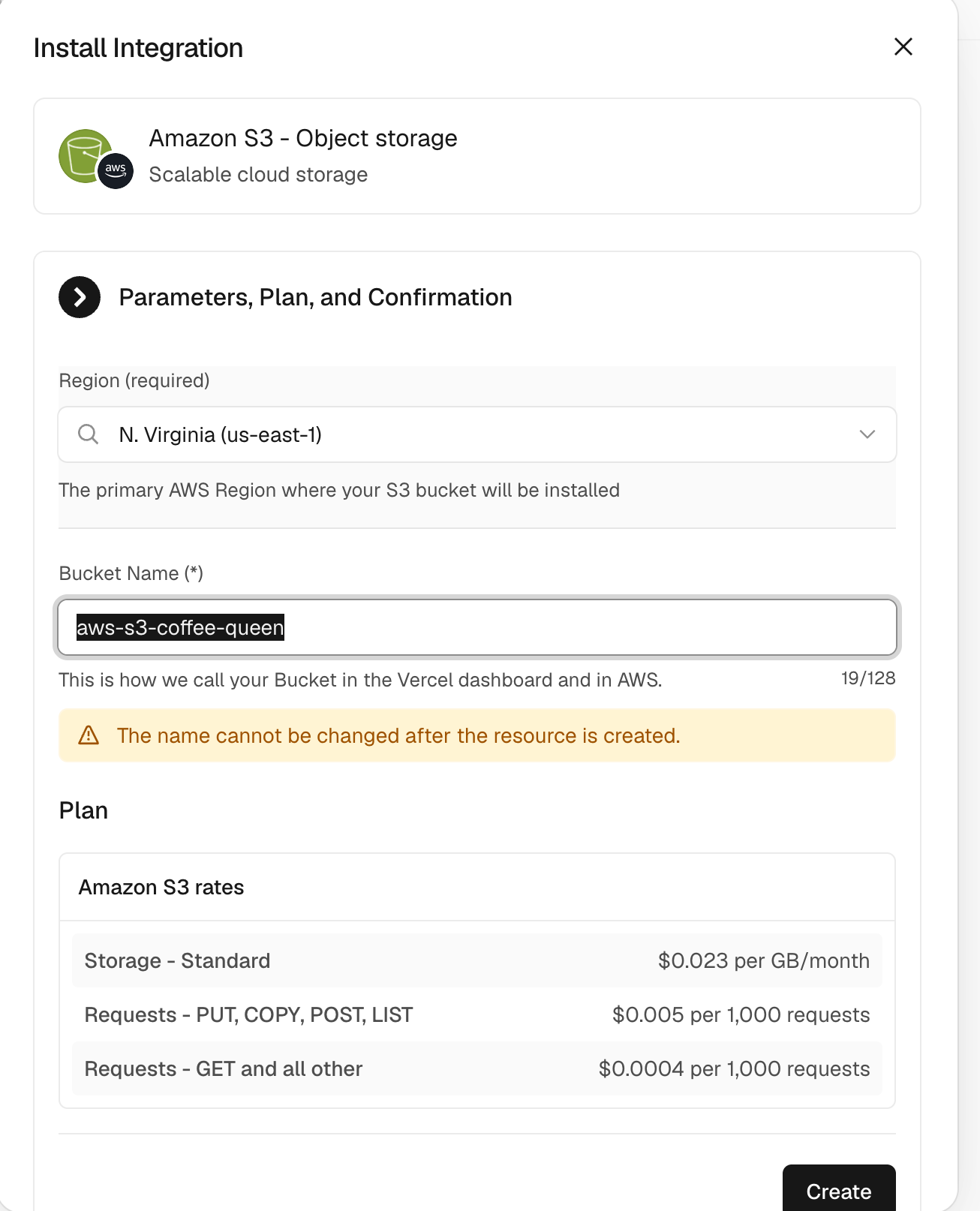
Developers building web and artificial intelligence applications on Vercel can now provision and manage Amazon Simple Storage Service (Amazon S3) resources directly through the Vercel Marketplace and the v0 generative development environment. This technical convergence pairs the durability, massive scalability, and performance of Amazon Web Services (AWS) storage with the streamlined, automated provisioning workflows characteristic of Vercel’s deployment platform.
The native integration encompasses general-purpose S3 object storage alongside specialized workloads, including Amazon S3 Tables and Amazon S3 Vectors. By addressing everyday asset management, large-scale analytics, and modern AI use cases under a single administrative umbrella, the platform aims to minimize the friction traditionally associated with multi-service cloud architecture.
Background and Strategic Context
Historically, the construction of performant web applications and data-intensive AI solutions required developers to operate across fragmented ecosystems. While frontend and full-stack frameworks gained speed through automated continuous integration and deployment pipelines, backend infrastructure provisioning often demanded manual intervention. Engineers routinely had to navigate the AWS Management Console to manually configure intricate security policies, establish Identity and Access Management (IAM) roles, and generate static access keys.
This operational overhead increased administrative costs and introduced security vulnerabilities, such as the accidental exposure of long-lived cryptographic credentials. Vercel and AWS have systematically worked to eliminate these barriers. The introduction of S3 natively into the Vercel Marketplace builds upon a lineage of previous integrations, including Amazon Aurora, Amazon DynamoDB, and Amazon OpenSearch Serverless.
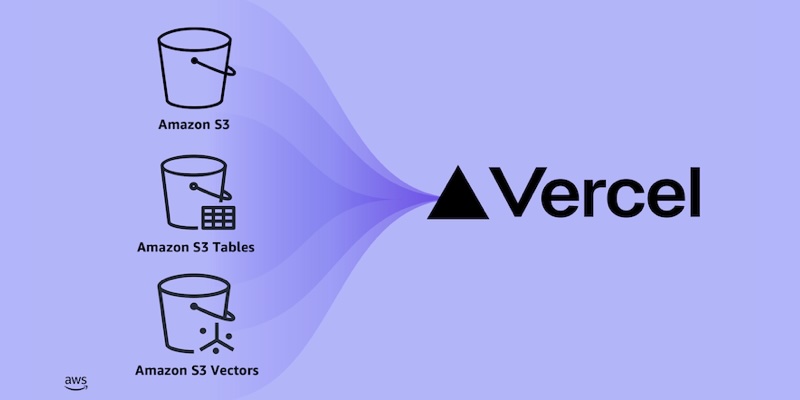
By unifying these services, developers can assemble a complete, end-to-end application stack entirely within the Vercel dashboard. This ecosystem enables teams to manage database layers, object stores, vector repositories, and open table storage formats within a single AWS account, reconciled through a unified billing structure.
Technical Architecture and Security Framework
The integration relies on modern authentication standards designed to eliminate the risks associated with static credentials. When a developer provisions a new S3 bucket, table bucket, or vector resource through the Vercel dashboard or via natural language commands in v0, the platform automatically generates the required environment variables, including AWS_REGION, AWS_ROLE_ARN, AWS_RESOURCE_ARN, and resource-specific identifiers.
At runtime, authentication is handled by the awsCredentialsProvider utility sourced from @vercel/functions/oidc. Instead of querying hardcoded keys stored in environment variables, serverless and edge functions dynamically exchange a short-lived OpenID Connect (OIDC) token with the AWS Security Token Service (STS). This cryptographic exchange yields temporary, highly scoped security credentials valid only for the duration of the execution lifecycle. Consequently, applications maintain principle-of-least-privilege access without requiring engineers to manually rotate or manage static secrets.
Storage Workloads: Object Storage, Analytics, and Vector Search
The native integration supports three distinct functional categories designed to address the diverse requirements of modern web and AI engineering:

-
Everyday Object Storage: General-purpose S3 buckets allow applications to ingest, store, and retrieve unstructured data such as user-uploaded media, documents, and static assets. Using the AWS SDK for JavaScript alongside Vercel’s OIDC credential provider, developers can implement standard CRUD operations within Next.js API routes or serverless functions with minimal boilerplate code.
-
Analytics via S3 Tables: Purpose-built for high-performance data analytics, Amazon S3 Tables offer fully managed Apache Iceberg tables that automatically optimize query performance and handle table maintenance and compaction as data volumes scale. Developers can query these tables directly from Vercel functions using lightweight analytical engines such as DuckDB. By attaching the S3 Table bucket via its Amazon Resource Name (ARN) and configuring appropriate security contexts, engineers can execute complex aggregate queries over massive datasets without standing up traditional data warehouse infrastructure.
-
Vector Search via S3 Vectors: Tailored specifically for AI agents, semantic search engines, and Retrieval-Augmented Generation (RAG) pipelines, S3 Vectors deliver optimized storage for high-dimensional embedding vectors. Because the system provides native support for storing and querying vectors directly within Amazon S3, development teams can bypass the complexity of maintaining a separate, dedicated vector database. Applications generate embeddings using their preferred machine learning models and query the S3 Vectors index via the
@aws-sdk/client-s3vectorsclient to identify the closest semantic matches for user queries.
Natural Language Provisioning with v0 by Vercel
Beyond traditional dashboard interactions, the integration is tightly coupled with v0 by Vercel, an AI-powered code generation tool. Engineers can use natural language prompts to describe the architecture they wish to build, prompting v0 to automatically provision the appropriate underlying S3 resource, configure the necessary connections, and generate functional frontend and backend code.
For example, a prompt requesting a "photo gallery where users upload images using AWS" automatically provisions a general-purpose S3 bucket and generates the corresponding upload logic. Similarly, a request for a "support bot that answers questions from my PDFs" deploys an S3 Vectors bucket, while a prompt for an "analytics dashboard for clickstream data" provisions S3 Tables. This capability dramatically shortens the proof-of-concept lifecycle, allowing developers to transition from architectural intent to a deployed preview environment in a matter of minutes.
Account Management and Integration Flexibility
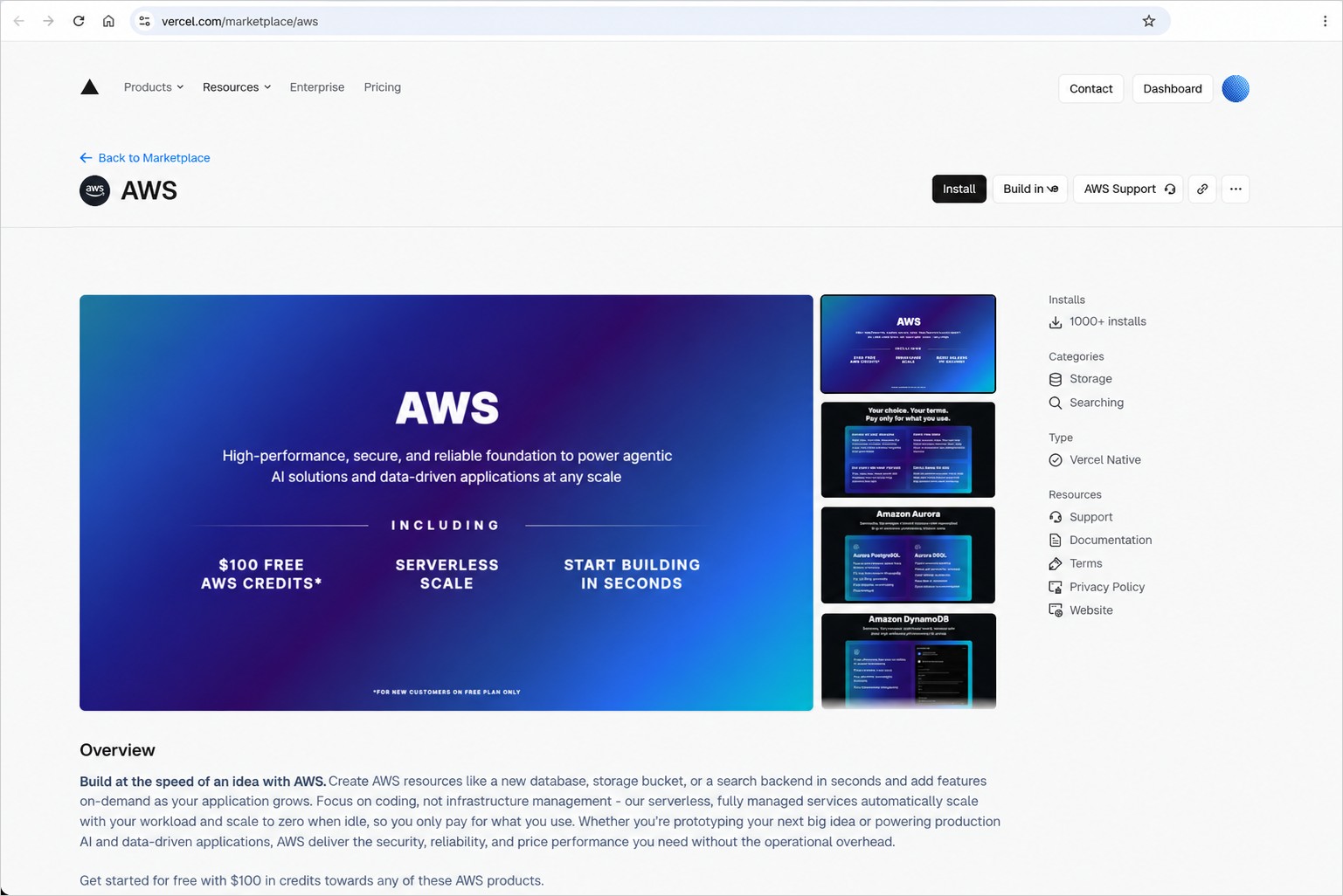
The platform provides flexible account linkage options to accommodate both greenfield projects and established enterprise environments. Development teams can choose to create a brand-new AWS account directly through the Vercel integration, which is optimized for rapid prototyping and testing. New accounts established through this pathway receive $100 in promotional AWS credits valid for a six-month period.
Alternatively, organizations with existing cloud infrastructure can link their current AWS accounts to the Vercel platform. This approach allows enterprises to leverage their existing enterprise agreements, maintain consolidated corporate billing, and utilize their full suite of AWS capabilities. To maintain strict security boundaries and prevent configuration drift, Vercel-managed workflows operate specifically on new buckets created through the platform, ensuring that existing production infrastructure remains untouched while granting teams access to native AWS tooling and centralized storage management.
Market Implications and Industry Analysis
The convergence of serverless web development platforms and enterprise cloud infrastructure reflects a broader industry shift toward developer-centric cloud architectures. Historically, infrastructure management and application development existed in distinct silos, often requiring specialized DevOps personnel to bridge the gap between code deployment and resource provisioning.
By abstracting the complexities of IAM configuration, credential management, and multi-service orchestration into automated workflows, platforms like Vercel and AWS are lowering the barrier to entry for building complex, data-driven applications. The inclusion of specialized workloads like S3 Tables and S3 Vectors indicates that cloud storage providers recognize the necessity of supporting modern AI and analytics pipelines natively, rather than forcing developers to stitch together disparate third-party services.
For enterprises and independent developers alike, this architectural model promises reduced time-to-market, enhanced security posture through ephemeral OIDC authentication, and simplified cost management through unified billing. As web applications increasingly incorporate real-time machine learning inferences and massive analytical queries, native integrations of this caliber establish a new baseline for developer productivity and cloud infrastructure design.
Availability and Getting Started
Amazon S3, including specialized support for S3 Tables and S3 Vectors, is available immediately across all commercial AWS regions supported by Vercel. There are no additional platform charges levied by Vercel for utilizing the integration; developers simply pay standard Amazon S3 consumption-based pricing for the underlying cloud resources.
Engineering teams can begin provisioning resources by navigating to the Storage tab within the Vercel dashboard or by interacting directly with the v0 interface. Comprehensive documentation, API references, and troubleshooting guides are maintained via official AWS resources, including the AWS MCP Server and the AWS re:Post community channels for Amazon S3.