AMD Unleashes Helios Rack System and Venice-X CPU, Challenging Nvidia’s AI Dominance with a Vision for a $1.4 Trillion Accelerator Market by 2030

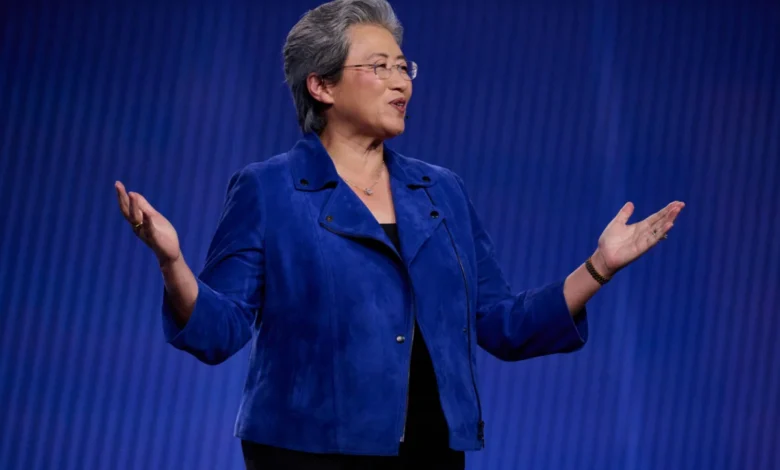
Advanced Micro Devices (AMD) has intensified its strategic offensive against rival Nvidia, unveiling its latest high-performance hardware designed to power the most demanding artificial intelligence (AI) workloads at a global scale. At its sold-out Advancing AI conference in San Francisco on Thursday, AMD Chair and CEO Dr. Lisa Su spearheaded the introduction of the Helios AI rack system, a formidable new entrant aimed squarely at the hyperscale AI market. Alongside this flagship product, Dr. Su highlighted a rapidly expanding roster of marquee customers, including tech giants like Microsoft, underscoring AMD’s aggressive push to capture a significant share of the burgeoning AI infrastructure market as Helios prepares for shipment later this year. The conference also served as a platform for AMD to present its newest generation of chips, meticulously engineered to satiate the insatiable computational appetite of the rapidly evolving AI industry.
The unveiling event on Thursday was more than just a product launch; it was a clear declaration of AMD’s intent to disrupt the established order in the high-stakes AI hardware arena, an area historically dominated by Nvidia. Dr. Su’s keynote address, delivered to a packed house of industry leaders, developers, and analysts, resonated with confidence, painting a picture of AMD as a full-stack solution provider ready to meet the complex demands of the "agentic AI" era. The Advancing AI conference itself has become a pivotal annual event for AMD, serving as its primary platform to showcase innovations in AI, high-performance computing (HPC), and data center technologies, signaling the company’s long-term commitment to these strategic growth areas.
Helios: AMD’s Bid for AI Rack Supremacy
At the core of AMD’s latest assault on the AI market is Helios, a rack-scale system engineered for unprecedented performance and scalability. Rack systems, by design, integrate numerous processors and supporting components into a single, high-density unit, optimized for deployment within massive data centers. These integrated units are the backbone of modern AI infrastructure, providing the raw computational power necessary to train sophisticated AI models and execute other compute-intensive tasks at scale. Dr. Su proudly proclaimed Helios as the tech industry’s "highest-performance AI rack," emphasizing its capability to "train and run the most demanding frontier models in the world at massive scale." The company further revealed ambitions for Helios to be deployed by leading AI enterprises at "gigawatt-scale," a testament to the immense power requirements and projected computational intensity of future AI applications.
The competitive landscape for such high-performance AI rack systems has long been defined by Nvidia, whose Vera Rubin and Grace Blackwell architectures have set industry benchmarks. Nvidia’s integrated hardware-software ecosystem, centered around its CUDA platform, has historically provided a significant competitive moat. However, AMD’s introduction of Helios, first revealed in 2025 and showcased publicly at CES 2026 in January, signals a determined effort to challenge this dominance. Early performance metrics, as reported by industry publications like The Register, suggest that Helios is indeed a formidable contender, reportedly surpassing Vera Rubin in several key performance indicators. While specific benchmarks were not fully detailed, such metrics typically include raw floating-point operations per second (FLOPS), memory bandwidth, interconnect speed, and energy efficiency, all critical factors for hyperscale AI deployments. The sheer physical presence of Helios, with a single rack reportedly weighing as much as two compact cars, underscores the density and power of this new system.
Strategic Partnerships and Hyperscale Deployments
AMD’s strategy extends beyond raw hardware power; it encompasses forging deep partnerships with the world’s leading AI innovators and cloud providers. The company has already secured a remarkable roster of well-known customers committed to deploying Helios, including OpenAI, Meta, Oracle, Anthropic, and Microsoft. These strategic alliances are crucial for AMD, providing immediate market traction, valuable feedback for future iterations, and a powerful endorsement of Helios’s capabilities.
Microsoft’s commitment, articulated by CEO Satya Nadella on Monday, is particularly significant. Nadella stated that Microsoft would expand its Azure infrastructure with Helios, integrating AMD’s cutting-edge systems into one of the world’s largest cloud computing platforms. This partnership not only provides AMD with a massive customer but also positions Helios as a foundational component for the development and deployment of next-generation AI services within Azure, directly competing with Nvidia’s strong presence in other cloud environments.
Further bolstering AMD’s position, Anthropic, a prominent AI research company known for its focus on AI safety and its Claude large language models, announced a strategic partnership with AMD on Wednesday. This collaboration involves the deployment of up to two gigawatts of AMD Instinct MI450 series GPUs via the new Helios rack system. The MI450 series, part of AMD’s Instinct accelerator lineup, is specifically designed for AI and HPC workloads, offering significant performance for complex neural network training. A two-gigawatt deployment is an astronomical figure, equivalent to the power output of multiple large nuclear power plants, highlighting the extreme scale of AI infrastructure that leading labs are now planning and building. Such large-scale deployments require not only powerful GPUs but also sophisticated cooling, power delivery, and high-speed networking solutions, all integrated seamlessly within the Helios framework. This partnership with Anthropic underscores the critical role AMD aims to play in the foundational development of advanced AI.
Expanding the Portfolio: Venice-X and the Future of Data Centers
Beyond Helios, AMD continues to innovate across its data center portfolio. During the Advancing AI conference, the company also introduced its Venice-X CPU, slated for launch in 2027. The Venice-X is specifically designed to tackle the most demanding high-computing workloads within data centers, featuring an impressive 1152 MB of 3D V-Cache, 96 cores, and a boost clock of 5.15 GHz. This next-generation CPU, based on the Zen 6 architecture, represents AMD’s ongoing commitment to pushing the boundaries of processor technology for high-performance computing (HPC) and AI inference tasks. While Helios focuses on the GPU-intensive training aspects of AI, Venice-X aims to bolster the CPU side of data center operations, crucial for general-purpose computing, data preprocessing, and orchestrating complex AI workflows. This dual-pronged approach, encompassing both high-performance GPUs and CPUs, reinforces AMD’s ambition to offer a comprehensive, full-stack solution for the modern data center.
The Agentic AI Era and a Trillion-Dollar Market
Dr. Lisa Su’s address transcended mere product announcements, offering a profound commentary on the trajectory of the chip industry and the transformative impact of AI. She posited that by the year 2030, chips specifically designed to power AI will constitute a massive, even dominant, segment of the overall computing market. This monumental shift, according to Su, is driven by a "step change in compute demand," largely instigated by the advent and proliferation of "agentic AI."
Agentic AI represents a paradigm shift from traditional, reactive AI systems. Instead of merely responding to prompts, agentic AI systems are designed to autonomously reason, plan, and execute multi-step tasks to achieve a given goal. As Dr. Su elaborated, "When you ask the agent to do something, it actually has dozens of steps, and it has to reason, and it has to call tools, and it has to access data, and it has to keep doing it over and over until it solves the problem, and so you need lots of GPUs to do all that." This iterative, complex problem-solving nature of agentic AI necessitates orders of magnitude more computational power than current AI models, creating an unprecedented demand for high-performance accelerators.
This surge in demand translates into staggering market projections. Dr. Su forecast that "by 2030, the AI accelerator market is going to reach about $1.4 trillion." To put this into perspective, she added, "What that means is, by the end of the decade, the AI accelerator market is going to approach the size of the entire semiconductor market today." This projection underscores the scale of opportunity AMD is targeting and the transformative economic impact AI is expected to have. The global semiconductor market, valued at over $500 billion in recent years, provides a stark comparison to the projected AI accelerator market, highlighting its anticipated exponential growth.
Furthermore, Dr. Su emphasized the enduring importance of Graphics Processing Units (GPUs) within this rapidly expanding market. "We do expect that GPUs are going to make up the vast majority of that market because the algorithms are still very much in their infancy, and we’re still continuing to see the workloads change, and that favors programmability in the overall silicon ecosystem," she stated. The adaptability and parallel processing capabilities of GPUs make them ideally suited for the iterative and evolving nature of AI algorithms, particularly during their developmental stages. While specialized AI accelerators (ASICs) may emerge for specific, well-defined tasks, the inherent flexibility of GPUs ensures their continued primacy in the dynamic landscape of AI research and deployment.
Competitive Landscape and Broader Implications
AMD’s aggressive foray into the AI rack system market with Helios and its continued investment in data center CPUs like Venice-X carries significant implications for the broader technology industry. Nvidia’s long-standing dominance, built on its powerful hardware and the pervasive CUDA software ecosystem, is now facing its most credible threat yet. AMD’s strategy revolves around not only matching or exceeding Nvidia’s hardware performance but also fostering its own software ecosystem, ROCm, to provide developers with a viable alternative to CUDA. The success of Helios and the MI450 GPUs will largely depend on the maturity and adoption of ROCm, as software compatibility and ease of development are critical for large-scale AI deployments.
The "gigawatt-scale" deployments mentioned by AMD and Anthropic highlight the escalating energy demands of advanced AI. Building and operating hyperscale AI data centers is an incredibly capital-intensive endeavor, requiring massive investments in real estate, power infrastructure, cooling systems, and specialized hardware. The efficiency of AI accelerators, measured in performance per watt, will become an increasingly critical differentiator in a world grappling with energy constraints and climate change concerns.
For enterprises and cloud providers, increased competition in the AI hardware market offers the potential for greater choice, innovation, and potentially lower costs. A more diversified supplier base could mitigate risks associated with reliance on a single vendor and foster a more dynamic ecosystem for AI development. AMD’s push could accelerate the pace of innovation across the entire AI hardware stack, benefiting researchers and businesses alike.
In conclusion, AMD’s Advancing AI conference marked a pivotal moment in the ongoing battle for AI supremacy. With the introduction of the Helios rack system, bolstered by significant customer endorsements and a compelling vision for the future of agentic AI, AMD has positioned itself as a formidable challenger to Nvidia’s long-held leadership. The projected $1.4 trillion AI accelerator market by 2030 serves as a powerful incentive for both companies to relentlessly innovate, shaping the very infrastructure upon which the next generation of artificial intelligence will be built. The coming years will undoubtedly witness an intense technological arms race, with AMD’s Helios and Venice-X leading its charge into this transformative era.
Related posts: