Microsoft Azure Databricks Delivers Unprecedented Return on Investment, Forrester Study Reveals Massive Economic Impact

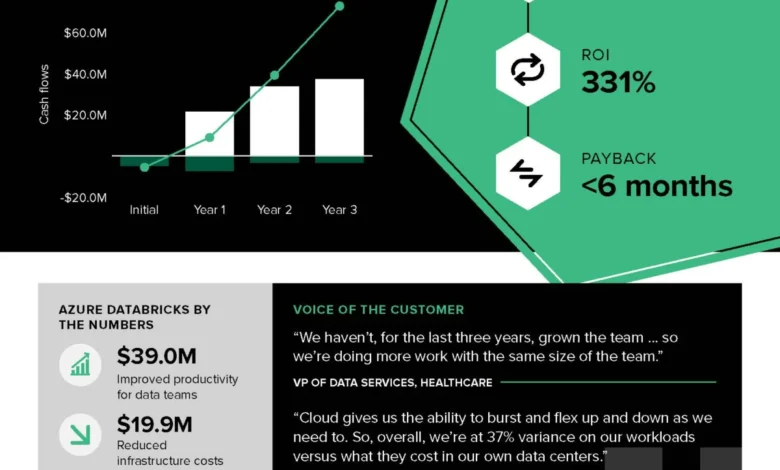
Microsoft Azure Databricks, the natively integrated Databricks platform on Microsoft Azure, has demonstrated significant economic advantages for organizations, according to a comprehensive Total Economic Impact™ (TEI) study commissioned by Microsoft and conducted by Forrester Consulting. The findings, released in June 2026, reveal a composite organization leveraging Azure Databricks achieved a staggering 331% return on investment (ROI) over three years, with a net present value (NPV) of $58.1 million and an investment payback period of less than six months. This substantial financial upside underscores the platform’s ability to drive tangible business value through deep integration, enhanced performance, and streamlined operations within the Azure ecosystem.
The study’s core revelation is that the "first-party advantage" of Azure Databricks translates into real, measurable value for customers. Unlike solutions that are bolted on, Azure Databricks is co-engineered by Microsoft and Databricks, benefiting from a unified integration roadmap across Microsoft’s extensive data and AI stack. This strategic alignment ensures a seamless experience for users, simplifying procurement with a single bill and offering a consolidated support path. For technical teams, this translates to deeper native integrations and superior performance. For the business, the advantages manifest as reduced costs, minimized risk, and a significantly accelerated time to value for data and AI initiatives.
The Forrester TEI study meticulously analyzed the impact of Azure Databricks on a composite organization. This hypothetical entity, based on interviews with actual Azure Databricks customers, represents a $6 billion company operating within a regulated industry and managing approximately 10 petabytes of data. Prior to adopting Azure Databricks, this organization faced a fragmented, costly, and unreliable data estate that posed significant governance challenges. Post-implementation, the study quantifies the transformative impact, projecting $75.6 million in total benefits against $17.5 million in costs over a three-year period, culminating in the impressive $58.1 million NPV.
The significant economic uplift identified in the study is attributed to four primary drivers, each contributing to both quantifiable financial gains and qualitative improvements:
- Increased Productivity of Data Science and Engineering Teams: The integrated nature of Azure Databricks within the Azure environment streamlines workflows for data scientists and engineers. This includes faster data preparation, reduced time spent on infrastructure management, and more efficient collaboration. The platform’s ability to handle large-scale data processing and complex analytics without the overhead of managing disparate tools empowers these teams to focus on innovation and delivering insights, rather than operational complexities.
- Reduced Infrastructure Costs: By leveraging Azure’s robust cloud infrastructure and the optimized architecture of Azure Databricks, organizations can achieve significant savings on hardware, software licensing, and maintenance. The platform’s scalability ensures that resources are provisioned and de-provisioned dynamically, aligning costs with actual usage and eliminating the inefficiencies of over-provisioning.
- Accelerated Time to Market for Data and AI Initiatives: The seamless integration with other Azure services, coupled with Databricks’ powerful analytics capabilities, dramatically speeds up the development and deployment of data-driven applications and AI models. This agility allows businesses to respond more rapidly to market opportunities, gain a competitive edge, and derive business value from their data assets much sooner.
- Improved Data Governance and Compliance: For organizations operating in regulated industries, robust data governance is paramount. Azure Databricks, particularly through its integration with Unity Catalog, provides a unified approach to data discovery, access control, and auditing. This ensures that data is managed securely and compliantly, mitigating risks and building trust in data-driven decision-making.
Beyond these financially quantified benefits, Forrester also highlighted several unpriced advantages that are critical to realizing the platform’s full potential. These include the native integration with Azure services, which simplifies architecture and management; the ability to generate insights faster, enabling more agile business responses; broader and more democratized access to data across the organization; and the enhanced governance capabilities offered by Unity Catalog, which ensures data security and compliance without hindering usability. These qualitative benefits lay the groundwork for the quantifiable returns observed in the study.
Deep Dive into the Value Drivers
The economic success of Azure Databricks stems directly from its fundamental design as a first-party Azure service. The co-engineering effort between Microsoft and Databricks ensures that the platform is deeply embedded within the Azure ecosystem, eliminating the need for costly data duplication, complex tooling, and extensive integration work that often plague multi-cloud or hybrid environments.
A prime example of this deep integration is the Azure Databricks Genie feature, which is increasingly being woven into the fabric of Microsoft’s productivity suite. Genie enables users to query their lakehouse environment using natural language, a capability now accessible within applications like Microsoft Teams and Microsoft 365 Copilot. This democratization of data access allows employees across various roles to derive insights without requiring specialized technical skills.
The integration further extends to Copilot Cowork, where Genie provides the contextual intelligence necessary to ground tasks in trusted data. This is achieved through Genie Ontology, which leverages Unity Catalog to ensure that users only access data they are authorized to see. This intelligent approach to data access ensures that insights are delivered directly into the flow of work without compromising organizational governance policies. This seamless blend of AI-powered insights and robust data security is a significant factor in driving both productivity and cost efficiencies.
The depth of integration is not limited to AI and productivity tools. Azure Databricks offers comprehensive connectivity with other critical Azure services:
- Azure Active Directory (Azure AD): Seamless single sign-on (SSO) and unified identity management simplify user access and enhance security.
- Azure Data Factory: Enables robust data integration pipelines, facilitating the movement and transformation of data into the lakehouse.
- Azure Synapse Analytics: Allows for the creation of comprehensive data warehousing and analytics solutions, complementing the lakehouse architecture.
- Power BI: Provides advanced business intelligence and data visualization capabilities, enabling users to explore and present data insights effectively.
- Azure Machine Learning: Offers a full suite of tools for building, training, and deploying machine learning models, leveraging the data housed in the lakehouse.
These integrations, while not always directly priced in the Forrester study, are instrumental in unlocking the productivity gains and cost savings that were quantified. They represent the foundational elements that allow organizations to move faster, operate more efficiently, and derive greater value from their data investments.
Independent Performance Benchmarks Bolster Claims
Beyond the economic impact study, the performance of Azure Databricks has also been independently validated. A benchmark study conducted by Principled Technologies, a respected independent firm, utilized an industry-standard TPC-DS-like decision-support benchmark on a 10-terabyte dataset. The results demonstrated a clear performance advantage for Azure Databricks.
In specific test scenarios, Azure Databricks completed a single query stream up to 21.1% faster than Databricks on AWS when autoscale was disabled. Furthermore, when running four concurrent query streams, Azure Databricks finished the workload more than nine minutes ahead of its AWS counterpart. These performance metrics are crucial, as they directly translate to faster query responses, reduced processing times, and ultimately, a more responsive and efficient data analytics environment. For businesses where speed is critical for decision-making, these performance gains are not merely technical advantages; they represent a tangible competitive edge.
Implications for Businesses Navigating the Data Landscape
The findings of the Forrester TEI study and the independent performance benchmarks carry significant implications for organizations grappling with the complexities of modern data and AI strategies. Choosing a data and AI platform is a long-term strategic decision, and the reinforced synergy of Azure Databricks within the Microsoft ecosystem offers a compelling value proposition.
The deep integration drives the cost savings identified by Forrester, ensuring that organizations are not burdened by the overhead of managing disparate systems. The enhanced performance metrics guarantee that these cost benefits are sustained even as data volumes and usage patterns grow. Crucially, this entire ecosystem is built on a foundation of a first-party partnership, meaning that organizations benefit from the combined engineering expertise, unified roadmaps, and dedicated support of both Microsoft and Databricks.
The measured return of 331% over three years, with a payback period under six months, transforms the discussion around data and AI investments from a cost center to a significant profit driver. This quantifiable success is a primary reason why an increasing number of teams are choosing to build their lakehouse architectures on Azure Databricks. The platform not only meets the technical demands of advanced analytics and AI but also delivers a robust economic case that aligns with strategic business objectives.
In an era where data is increasingly recognized as a critical business asset, the ability to leverage it effectively, efficiently, and securely is paramount. Azure Databricks, through its native integration, performance leadership, and demonstrated economic value, provides a comprehensive solution that empowers organizations to unlock the full potential of their data and AI initiatives.
The comprehensive nature of the Forrester study provides decision-makers with the critical data needed to evaluate the true economic impact of adopting Azure Databricks. The combination of deep technological integration, validated performance, and a clear path to significant ROI positions Azure Databricks as a leading platform for organizations looking to thrive in the data-driven future. The study serves as a powerful testament to the strategic advantage of a co-engineered, first-party cloud service that is designed to deliver maximum business value.