Abbott Laboratories Grapples with Dual Cyberattack Investigations Following Alleged Breaches by ShinyHunters and ShadowByt3$


Abbott Laboratories, a global healthcare giant, is currently embroiled in investigations into two distinct cybersecurity incidents, confirming unauthorized access to internal legacy systems within its Cancer Diagnostics business and simultaneously probing claims of a separate breach impacting its LabCentral customer portal. These incidents underscore the escalating threat landscape facing the highly sensitive and critical healthcare sector, highlighting sophisticated attack vectors and the persistent risk posed by cybercriminal groups.
The first confirmed incident, affecting legacy Exact Sciences systems within Abbott’s Cancer Diagnostics business, came to light after the notorious ShinyHunters extortion gang listed Abbott on its data leak site. The group initially issued a threat to publish purportedly stolen data after July 18 if negotiations were not initiated, a deadline later extended to July 21. This public declaration by ShinyHunters immediately triggered a response from Abbott, which swiftly initiated its incident response protocols.
Upon inquiry regarding the ShinyHunters incident, Abbott directed media outlets to an official statement published on its corporate newsroom. The statement acknowledged, "Abbott is investigating a cyber incident in which there was unauthorized access to a limited number of internal systems in our Cancer Diagnostics business only." Crucially, the company sought to reassure stakeholders and the public, asserting, "This does not impact any business operations, product or product availability, manufacturing or lab operations, or our ability to serve patients." Abbott further clarified that the security breach was isolated, not affecting any other Abbott businesses or systems, emphasizing the separation of the compromised legacy Exact Sciences systems from the broader Abbott infrastructure. The company confirmed it has engaged cybersecurity experts and notified law enforcement agencies as part of its comprehensive investigation, adding that it does not anticipate a material impact on its business or financial results from this incident.
ShinyHunters, a prominent data extortion group known for its audacious and often successful social engineering campaigns, provided additional details to BleepingComputer regarding their alleged method of intrusion. The group claimed to have gained access through a sophisticated vishing attack targeting several Abbott employees in mid-June. Vishing, a form of phishing that relies on voice communication, often involves attackers impersonating trusted entities to manipulate victims into divulging sensitive information or performing actions that compromise security. According to ShinyHunters, this vishing attack enabled them to compromise a Microsoft Entra single sign-on (SSO) account, which subsequently granted them unauthorized access to internal systems.
This alleged method aligns with ShinyHunters’ established modus operandi. Since last year, the extortion group has been actively conducting social engineering campaigns specifically designed to target employees’ SSO accounts across various platforms, including Microsoft Entra, Okta, and Google. Their typical strategy involves leveraging compromised SSO credentials to gain access to a multitude of connected Software-as-a-Service (SaaS) applications. These can include critical business platforms such as Salesforce, Microsoft 365, Google Workspace, SAP, Slack, Adobe, Atlassian, Zendesk, and Dropbox, among many others, allowing them to exfiltrate vast amounts of corporate data.

The data allegedly stolen by ShinyHunters from Abbott’s systems, as claimed by the threat actor, is extensive and highly sensitive. They assert to have exfiltrated information from Microsoft Entra, ServiceNow, SharePoint, Databricks, and Coupa. The stolen data reportedly includes internal documents, contracts, and customer information. More alarmingly, ShinyHunters claimed to have acquired over 30 million rows of customer personally identifiable information (PII) from multiple datasets, encompassing names, email addresses, phone numbers, physical addresses, and dates of birth. The group also alleged the theft of more than one million Social Security numbers, alongside over 22 million client notes containing doctor-patient conversations, and more than 20 million medical orders. Furthermore, customer agreements and non-disclosure agreements (NDAs) were also purportedly compromised. It is important to note that, at the time of reporting, these specific claims regarding the scope and nature of the stolen data by ShinyHunters have not been independently verified.
The healthcare sector has become an increasingly lucrative target for cybercriminal organizations like ShinyHunters. The group has demonstrated a particular focus on medtech companies, having previously been linked to high-profile breaches at entities such as Medtronic, OneMedical, and AdaptHealth. BleepingComputer has also reported ShinyHunters’ alleged involvement in the iRhythm data breach and their targeting of Stryker shortly after that company recovered from a destructive Iranian data-wiping attack. This pattern underscores the persistent and evolving threat faced by organizations handling sensitive health and medical device data, where the compromise of even legacy systems can have far-reaching implications for patient privacy and operational integrity.
The Alleged Breach at LabCentral Customer Portal
Adding another layer of complexity to Abbott’s cybersecurity challenges, a second distinct incident involves a threat actor identifying themselves as ShadowByt3$. This group contacted BleepingComputer, claiming to have breached Abbott’s Core Laboratory diagnostics business through its LabCentral customer portal. ShadowByt3$ asserted that they gained access to the unit by exploiting what they described as a "weak point" in the environment, utilizing compromised customer credentials.
According to ShadowByt3$’s account, the intrusion occurred on July 4, 2026, after which they systematically exfiltrated files by targeting API endpoints over a period. The data purportedly stolen by ShadowByt3$ includes a range of sensitive business and intellectual property documents. Specifically, the group claims to have obtained CE manufacturing certificates, operation manuals, technical specifications, regulatory documentation, product requirement archives, calibrator value assignments, assay files, and various other product documentation directly related to Abbott’s laboratory diagnostic systems. While ShadowByt3$ maintained that no customer data was compromised in this particular incident, they emphasized the acquisition of sensitive business documents and intellectual property. As purported proof of their intrusion, the group provided BleepingComputer with screenshots and a file listing.
Abbott, while acknowledging awareness of this "potential" cyber incident, offered a differing characterization of the nature of the data involved. An Abbott spokesperson confirmed to BleepingComputer that LabCentral is "an externally facing third-party hosted portal used by Abbott’s core laboratory diagnostics business." However, the company disputed ShadowByt3$’s claims regarding the sensitivity of the stolen data, stating, "It houses publicly available technical product reference documents, including operating manuals, troubleshooting checklists and product specifications, and does not contain proprietary/sensitive customer or business information." This divergence in claims between the threat actor and Abbott highlights a common challenge in post-breach assessments, where the perceived value and sensitivity of exfiltrated data can vary significantly between the parties involved.
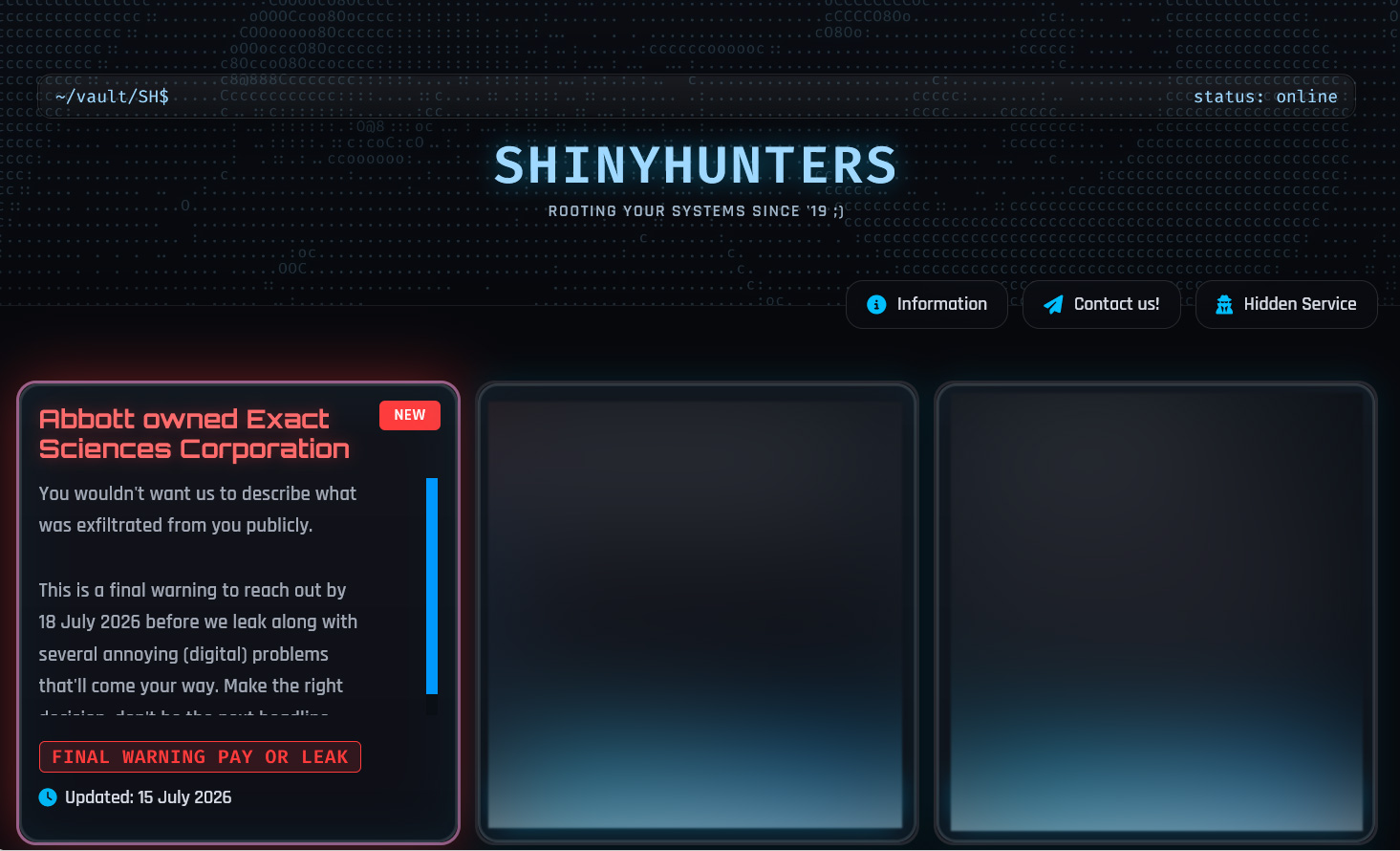
As of the current reporting, neither ShinyHunters nor ShadowByt3$ has publicly released the data they claim to have stolen from Abbott, indicating that the situations remain dynamic and potentially subject to further developments, including ongoing negotiations or investigative efforts.
Chronology of Events
- Mid-June (exact date undisclosed): ShinyHunters allegedly executes a vishing attack targeting multiple Abbott employees, leading to the compromise of a Microsoft Entra SSO account and initial unauthorized access to legacy Exact Sciences systems.
- July 4, 2026: ShadowByt3$ claims to have gained initial access to Abbott’s LabCentral customer portal using compromised customer credentials.
- July 18: ShinyHunters adds Abbott to its data leak site, threatening to publish stolen data if negotiations do not commence by this date.
- Post-July 18: Abbott issues a public statement confirming an investigation into unauthorized access to a limited number of internal systems in its Cancer Diagnostics business (Exact Sciences).
- July 21: ShinyHunters extends its data publication deadline, indicating ongoing engagement or strategic maneuvering.
- Ongoing: Abbott continues investigations into both incidents, engaging cybersecurity experts and notifying law enforcement. Both ShinyHunters and ShadowByt3$ have yet to publicly release any data.
Broader Implications for Abbott and the Healthcare Sector
These dual cyber incidents present significant challenges and implications for Abbott Laboratories and the broader healthcare industry. For Abbott, a company with a market capitalization exceeding hundreds of billions of dollars and a global footprint, maintaining robust cybersecurity is paramount to its operations, reputation, and patient trust.
The compromise of legacy Exact Sciences systems, even if isolated, raises concerns about the security posture of older infrastructure within large, complex organizations. Legacy systems often lack modern security features, making them attractive targets for sophisticated threat actors. Furthermore, the alleged theft of extensive PII, including Social Security numbers, medical orders, and doctor-patient conversations, could expose Abbott to severe regulatory scrutiny under privacy laws such as the Health Insurance Portability and Accountability Act (HIPAA) in the United States, and potentially the General Data Protection Regulation (GDPR) in Europe if data pertaining to EU citizens was involved. Violations of these regulations can result in substantial fines, legal liabilities, and mandatory data breach notifications, which can further damage reputation and incur significant operational costs. The alleged theft of intellectual property from the LabCentral portal, even if Abbott disputes its sensitivity, could also have long-term competitive implications.
Beyond the immediate financial and legal ramifications, these incidents could impact Abbott’s reputation. In an industry built on trust and the secure handling of sensitive health information, any breach, regardless of its ultimate impact on core operations, can erode confidence among patients, healthcare providers, and investors. The involvement of well-known extortion groups like ShinyHunters also underscores the increasing professionalism and persistence of cybercriminals targeting critical infrastructure sectors.

For the wider healthcare sector, these events serve as a stark reminder of the evolving and persistent threat landscape. Healthcare organizations are prime targets due to the wealth of highly valuable personal and medical data they possess, which can be monetized through identity theft, fraud, or extortion. The reliance on third-party portals and legacy systems across the industry creates numerous potential entry points for attackers. The effectiveness of vishing and SSO account compromises highlights the need for continuous employee training on social engineering tactics, multi-factor authentication (MFA) implementation, and robust identity and access management controls. Cybersecurity resilience in healthcare requires a multi-layered approach, encompassing technical safeguards, human awareness, and comprehensive incident response planning.
Conclusion
Abbott Laboratories’ current predicament, navigating two distinct cybersecurity investigations, underscores the relentless and sophisticated nature of modern cyber threats. While the company has taken swift action, engaging experts and notifying law enforcement, the full scope and long-term implications of these alleged breaches remain to be seen. The claims made by ShinyHunters regarding the vast quantity and sensitive nature of stolen data, though unverified, highlight the potential for significant patient impact and regulatory challenges. Similarly, the LabCentral incident, despite Abbott’s assertion of non-sensitive data, points to potential vulnerabilities in external-facing portals. As investigations continue and the situation unfolds, these incidents will likely serve as another critical case study for the healthcare industry, reinforcing the urgent need for continuous vigilance, proactive security measures, and adaptive strategies to protect invaluable patient data and intellectual property in an increasingly digital and interconnected world.
Related posts: