In the vast, silent tapestry of the cosmos, human perception often gravitates toward the massive: the spiraling giants like the Milky Way or the colossal elliptical galaxies that anchor massive clusters. Yet, recent observations from the Hubble Space Telescope suggest that the true architects of galactic chemical evolution may be the universe’s smallest residents. Dwarf galaxies, specifically NGC 4449, serve as a prime case study for how these diminutive stellar systems exert an influence far greater than their physical size would suggest.
The Anatomy of a Dwarf Galaxy
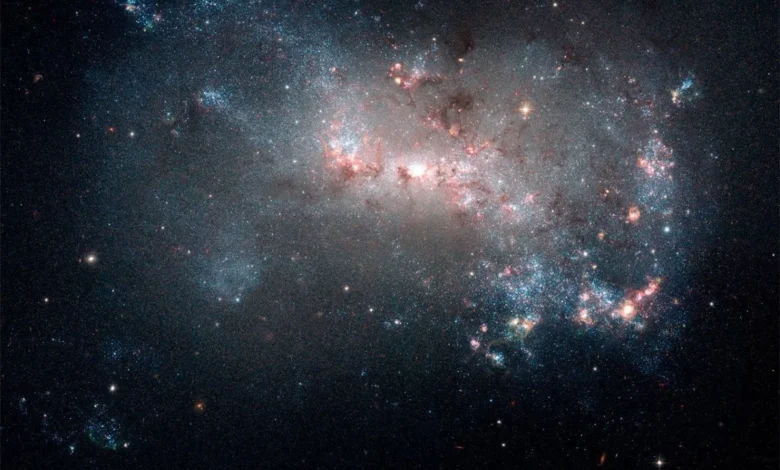
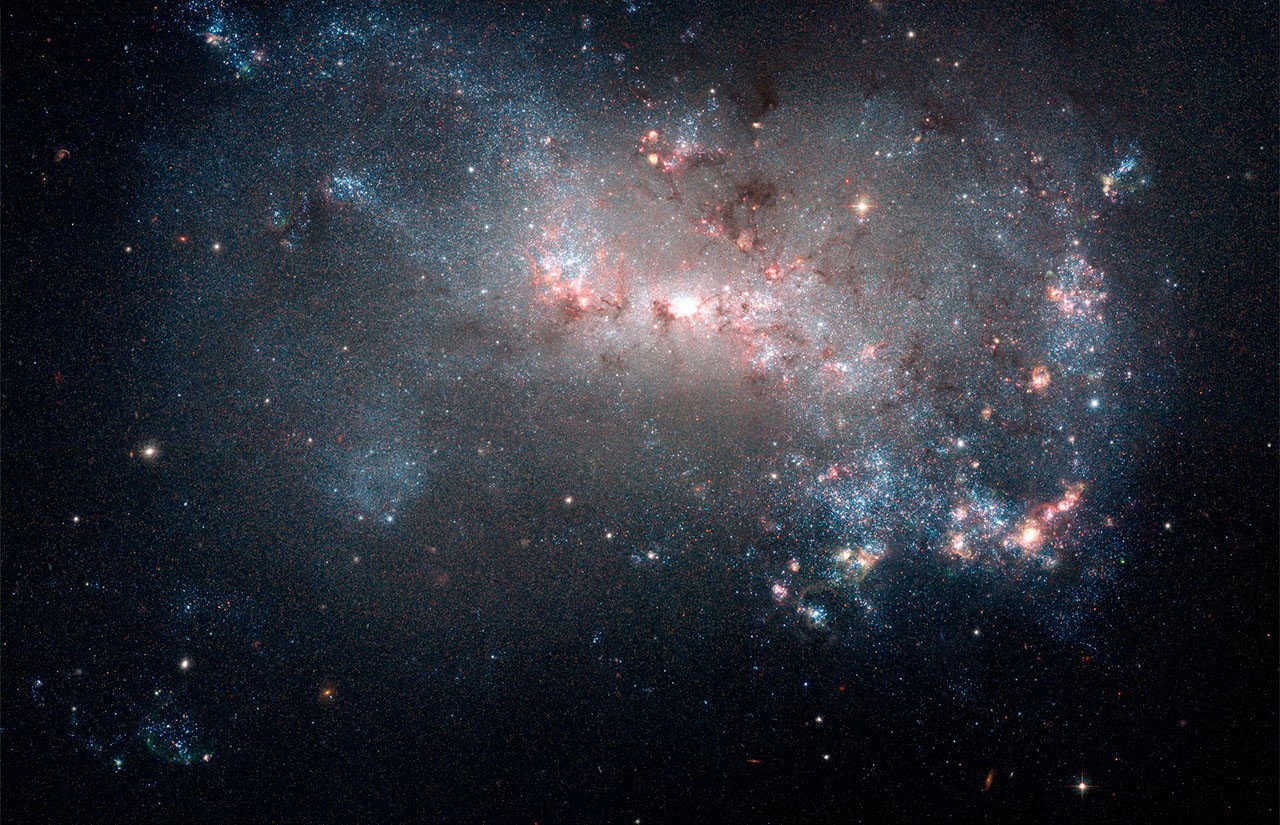
NGC 4449 is a quintessential example of a starburst dwarf galaxy located approximately 12 million light-years away in the constellation Canes Venatici. Unlike the structured, orderly disks of spiral galaxies, NGC 4449 presents a chaotic, "bow-tie" appearance. This morphological irregularity is characterized by vibrant pockets of ionized hydrogen gas, which glow with a distinct pink hue in imagery, interspersed with clusters of hot, blue-white stars.
To understand the significance of NGC 4449, one must first establish the scale of the cosmic hierarchy. The Milky Way, a massive barred spiral galaxy, spans roughly 100,000 light-years and houses between 100 and 400 billion stars. In stark contrast, dwarf galaxies—the most numerous galactic classification in the observable universe—typically contain only a few billion stars and measure a fraction of the size of the Milky Way. Despite their relative insignificance in terms of sheer mass, these systems are dynamic laboratories of stellar birth and death.
Chronology of Observation and Discovery
The study of NGC 4449 has spanned decades of modern astronomical research. While it was first cataloged by William Herschel in 1788, the modern era of high-resolution analysis began with the deployment of the Hubble Space Telescope.
- 1990s: Hubble’s initial missions provided the first clear visual evidence of the intense star-forming regions within NGC 4449, confirming it as a "starburst" galaxy—a system undergoing a period of exceptionally high rates of star formation.
- 2010s: Advanced spectroscopic analysis revealed an anomaly: the galaxy appeared to be deficient in oxygen compared to standard stellar evolution models.
- 2026 (Present): Current research, supported by ongoing observations from NASA and the European Space Agency (ESA), has solidified the theory that these galaxies are not merely passive collectors of matter, but active exporters of heavy elements into the intergalactic medium (IGM).
The Oxygen Deficiency Paradox
The most compelling scientific finding regarding NGC 4449 concerns the "missing oxygen." In astrophysical terms, oxygen is a heavy element (or "metal") produced within the cores of massive stars. When these stars reach the end of their life cycles, they collapse and explode as supernovae, dispersing these heavy elements into the surrounding interstellar space.
Models of galactic formation traditionally predicted that a galaxy the size of NGC 4449 should retain a specific concentration of these elements. However, observational data indicates that NGC 4449 possesses significantly less oxygen than expected. This discrepancy is not a sign of absent star formation, but rather evidence of a highly efficient delivery system.
Research teams, including those associated with the Hubble Heritage project and the Space Telescope Science Institute (STScI), have inferred that the stellar winds and the cumulative energy from supernovae in these dwarf galaxies are powerful enough to overcome the galaxy’s relatively weak gravitational pull. Effectively, these galaxies are "blowing away" their chemical output, enriching the space between galaxies with the very ingredients necessary for the formation of subsequent generations of stars and planets.
Implications for Galactic Chemical Evolution
The implications of this discovery are profound for our understanding of the universe’s chemical enrichment. If dwarf galaxies are indeed the primary conduits for spreading heavy elements, they are essentially the gardeners of the cosmos.
- Intergalactic Enrichment: The heavy elements expelled by NGC 4449 do not simply vanish. They permeate the IGM, providing the raw materials for future star formation in neighboring regions or larger galaxies that accrete this material.
- Stellar Lifecycle Influence: Without this process of distribution, the chemical composition of the universe would be far more stratified. By moving metals from the dense centers of small galaxies into the vast, empty reaches of space, dwarf galaxies facilitate a more uniform distribution of the building blocks of life.
- Refining Cosmological Models: The fact that current models failed to predict the extent of this oxygen loss forces astrophysicists to refine their simulations regarding feedback mechanisms in galaxy evolution. It suggests that stellar feedback—the collective impact of radiation and supernova shockwaves—is a dominant force in shaping the evolution of small-scale structures.
Official Perspectives and Technical Context
The data presented in the latest imagery is the result of a multi-agency collaboration. The credit for the specific imaging released today goes to NASA, the ESA, and A. Aloisi of the STScI/ESA, in partnership with the Hubble Heritage Collaboration. These teams utilize multi-wavelength observations to distinguish between the various components of the galaxy, such as the dark dust streaks, the ionized gas, and the clusters of young, massive stars.
The technical analysis of such imagery is a complex, iterative process. Astronomers must separate the light from different types of stars and gas clouds to map the distribution of elements. As noted by the editors of the Astronomy Picture of the Day—including Keighley Rockcliffe and Robert Nemiroff—these images serve not just as aesthetic wonders, but as critical datasets for ongoing research into the "missing metals" problem.
Broader Impact on Modern Astrophysics
The study of NGC 4449 is part of a larger, ongoing effort to map the "galactic ecosystem." By understanding how dwarf galaxies function, scientists can better reconstruct the early history of the universe. In the early epochs of the cosmos, dwarf galaxies were significantly more common and were the primary sites of star formation. Consequently, the mechanisms observed in NGC 4449 today were likely the primary drivers of chemical enrichment during the universe’s formative years.
Furthermore, the study highlights the necessity of high-resolution space-based observation. Ground-based telescopes, while powerful, must contend with the distortion of the Earth’s atmosphere. Hubble’s position in low-Earth orbit allows it to capture the fine, intricate details of NGC 4449—such as the specific density of gas clumps and the distribution of dust—that would otherwise remain obscured.
Conclusion
The narrative of NGC 4449 serves as a poignant reminder that in astronomy, size is not synonymous with importance. While the Milky Way provides the context of our own existence, the dwarf galaxies of the universe are the engines of its chemical complexity. By studying these "little galaxies with big mysteries," as described by the European Southern Observatory, the global scientific community is piecing together the complex, interconnected history of the cosmos.
As we continue to peer deeper into the universe, the story of NGC 4449 will likely remain a focal point for those seeking to understand how the building blocks of life—carbon, oxygen, and iron—came to be scattered across the expanse of space. Whether through the lens of a telescope or the simulations of a supercomputer, the conclusion remains clear: the universe is a dynamic, shifting environment, and its smallest inhabitants may well be its most vital participants. The ongoing commitment of NASA and its international partners to document these systems ensures that the census of our cosmic neighborhood continues to grow, providing a more comprehensive understanding of the forces that have defined the last 13.8 billion years of history.