Scientists may have found the first exomoon, except this one is the size of Jupiter

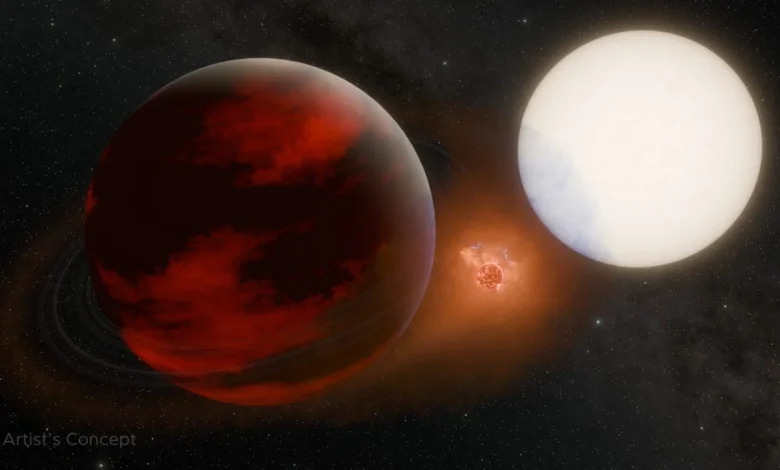
The quest to find celestial bodies orbiting planets beyond our solar system has taken a significant, albeit perplexing, turn with the potential discovery of the first exomoon. This groundbreaking finding, however, comes with a caveat: the object in question is not a dainty satellite akin to Earth’s Moon, but rather a behemoth with a mass comparable to that of Jupiter. This colossal candidate, identified in the CD-35 2722 system, challenges our very definition of what constitutes a moon and offers a tantalizing glimpse into the diverse and often extreme nature of planetary systems across the cosmos.
For decades, astronomers have been diligently cataloging exoplanets, with over 6,000 confirmed worlds now known to exist outside our immediate cosmic neighborhood. Yet, the detection of natural satellites orbiting these distant planets, or exomoons, has remained an elusive goal. The subtle gravitational signatures and observational complexities involved in spotting such smaller companions around alien worlds have made this pursuit considerably more challenging than planet hunting. This latest development, observed using the European Southern Observatory’s Very Large Telescope (VLT) in Chile, could finally mark a turning point in this endeavor, though the sheer scale of the candidate necessitates a re-evaluation of our astronomical classifications.

A Cosmic Anomaly: The Enigma of the Giant Exomoon Candidate
The celestial system under scrutiny, CD-35 2722, is already a departure from the familiar architecture of our own solar system. It is centered around a young star that possesses roughly half the mass of our Sun. This star hosts a prominent companion, CD-35 2722 B, which is not a typical planet but rather a brown dwarf. Brown dwarfs occupy a fascinating intermediate category in the stellar hierarchy, possessing masses far greater than the largest gas giants but falling short of the threshold required for sustained nuclear fusion that defines true stars. In this case, CD-35 2722 B boasts a mass approximately 37 times that of Jupiter.
It is around this massive brown dwarf that the potential exomoon has been detected. Initial estimates suggest a minimum mass of around 0.9 Jupiter masses, placing it squarely in the planetary realm by conventional definitions. Its orbital period around the brown dwarf is estimated to be approximately 170 Earth days. This colossal size, coupled with its host being a brown dwarf, has led researchers to adopt the more cautious term "exosatellite" for now. The absence of a formally accepted definition for an exomoon further complicates the classification, especially when the host object itself resides in a gray area between planets and stars.
The Observational Journey: Unraveling the Gravitational Dance
The discovery of this gargantuan exomoon candidate was made possible through the application of a well-established exoplanet-hunting technique: radial velocity measurements. Astronomers utilized the sophisticated CRIRES+ instrument on the VLT, a powerful spectrograph capable of detecting minute shifts in the light emitted by a star or brown dwarf. This method relies on observing the subtle gravitational "wobbles" that an orbiting celestial body induces in its host. These wobbles cause slight variations in the object’s radial velocity – its speed towards or away from the observer – which are imprinted on its light spectrum as Doppler shifts.
This radial velocity technique was famously instrumental in the discovery of the first exoplanet orbiting a Sun-like star. In the case of CD-35 2722, the researchers applied this technique not to a star, but directly to the brown dwarf CD-35 2722 B. By meticulously analyzing the subtle gravitational tugs exerted by the unseen companion on the brown dwarf, the team was able to infer the presence and characteristics of this massive orbiting object.
While the evidence is compelling, further observations are deemed necessary to definitively confirm the existence of this exomoon candidate. The scientific community operates under a rigorous standard for such extraordinary claims, and definitive confirmation will likely involve multiple independent observations and potentially the use of complementary detection methods.
Contextualizing the Discovery: Exomoons and the Search for Life
The potential discovery of an exomoon, regardless of its size, holds profound implications for our understanding of planetary formation and the prevalence of potentially habitable environments beyond Earth. Moons, particularly rocky moons with atmospheres and internal heat sources, are increasingly being considered as prime candidates in the search for extraterrestrial life. Jupiter’s moon Europa and Saturn’s moon Enceladus, within our own solar system, are prime examples of icy worlds that may harbor subsurface oceans, making them tantalizing targets for astrobiological exploration.

The existence of exomoons could significantly expand the number of potential abodes for life. If moons can form around planets in the habitable zones of their stars – the region where liquid water could exist on a planet’s surface – they might offer a more stable and protected environment for life to emerge and evolve, shielded from the harsh radiation of their host star or the disruptive gravitational influences of other planets.
However, the immense size of the current candidate introduces new questions. A Jupiter-sized moon orbiting a brown dwarf presents a scenario far removed from the familiar dynamics of our solar system. The formation mechanisms for such a colossal satellite around a brown dwarf are not fully understood and may involve processes significantly different from those that shaped our own planetary system. It raises questions about the stability of such systems and the potential for life to arise in such extreme environments.

Future Prospects: The Era of Giant Telescopes
The detection of this massive exomoon candidate is a testament to the increasing sensitivity and power of astronomical instruments. The VLT, with its advanced spectrographic capabilities, has pushed the boundaries of what can be observed. Looking ahead, the next generation of telescopes promises to revolutionize exomoon detection even further.
The European Southern Observatory’s Extremely Large Telescope (ELT), with its massive 39-meter primary mirror, is poised to be a game-changer. Its unparalleled light-gathering power and resolution will enable astronomers to probe the atmospheres of exoplanets with unprecedented detail and to detect smaller, more Earth-like exomoons around a wider range of host stars. Advances in observational techniques, coupled with the development of sophisticated data analysis algorithms, will undoubtedly lead to a surge in exomoon discoveries in the coming years.

The potential discovery of this colossal exomoon candidate around a brown dwarf in the CD-35 2722 system serves as a powerful reminder of the vast and often surprising diversity of the universe. While it may stretch the conventional definition of a moon, it highlights the ongoing evolution of our understanding of cosmic architecture and the potential for unexpected celestial bodies to challenge our preconceived notions. As astronomers continue to refine their techniques and deploy ever more powerful instruments, the prospect of finding not just one, but many exomoons – perhaps even ones that more closely resemble our own familiar Moon – grows increasingly likely, bringing us closer to answering the age-old question: are we alone?