Chaos Engineering Becomes Critical for Multi-Million Dollar GPU Clusters Powering AI

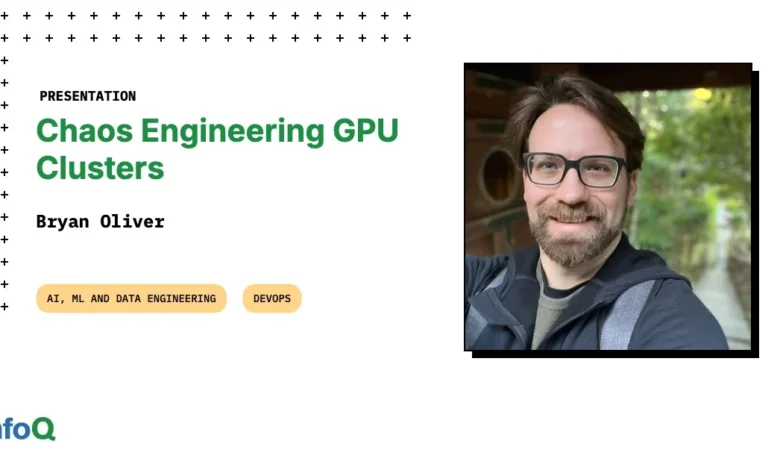
The escalating complexity and exorbitant costs associated with large-scale GPU clusters, the backbone of modern artificial intelligence, necessitate a radical rethinking of reliability engineering. As AI workloads move from specialized research environments to mainstream production, traditional approaches to ensuring system resilience are proving woefully inadequate. This pressing challenge was highlighted by Bryan Oliver of Thoughtworks, a leading authority on platform engineering and the Thoughtworks Radar, who is also authoring a new O’Reilly book, "Designing Intelligent Delivery Systems," focusing on emerging scheduling patterns in AI deployments. Oliver, a frequent speaker and contributor to open-source projects like Kubernetes, underscored the immense difficulty of navigating this rapidly evolving landscape, asserting that "no one has more than a year of experience in this space at this scale." His insights reveal a burgeoning "chaos gap" that enterprises must address to prevent catastrophic financial and operational losses.
The Proliferation of GPU Supercomputing
To appreciate the scale of the challenge, one must first grasp the sheer power and cost of the GPUs driving today’s AI. These are not the consumer-grade graphics cards found in gaming desktops, but specialized behemoths designed for massive parallel computation. A high-end gaming GPU, like an NVIDIA 4090, might boast 24 gigabytes of VRAM and 10,000 CUDA cores. In stark contrast, an NVIDIA H100, a workhorse in AI data centers, features 94 GB of VRAM per GPU and 16,000 CUDA cores, often deployed in multi-GPU configurations, offering hundreds of gigabytes of VRAM and 400 GB/s of network bandwidth per chip.
Pushing the boundaries further is NVIDIA’s GB200 Grace Blackwell Superchip. This "monster" delivers a staggering 384 GB of VRAM per chip and is integrated into rack-scale systems comprising 72 such chips, functioning as a single, unified GPU with 13 to 14 terabytes of total virtual memory. The cost of such a rack? Approximately $3 million, a figure that underscores the financial stakes involved in ensuring their uninterrupted, optimal operation.
The journey to these powerful clusters began decades ago with high-performance computing (HPC) in the 1960s and 70s. A pivotal moment arrived in 2004 when researchers at Stony Brook University’s Center for Visual Computing, modeling chemical and biological attacks in urban areas, discovered that running their simulations on a 30-node GPU cluster yielded a 100x performance gain over CPU clusters. This was two years before NVIDIA released CUDA in 2006, forcing these pioneers to "trick the GPU into doing science by pretending it was rendering pixels." CUDA subsequently ignited the explosion of GPU clusters, setting the stage for the large language models (LLMs) of the 2020s and the current industry-wide call for robust AI infrastructure on platforms like Kubernetes.
Kubernetes’ Pivotal Role in the AI Era
The convergence of massive GPU power and the demands of LLMs has placed Kubernetes at a critical juncture. At KubeCon Paris early last year, Tim Hockin, a prominent Kubernetes contributor, issued a stark warning: "We have succeeded in creating a general engineering platform for microservices and APIs, now we need to address AI, or our project is going to die and be replaced." This declaration marked a turning point, shifting Kubernetes’ focus firmly towards supporting AI workloads.
The impetus for this shift lies in the limitations of existing solutions like Slurm, a workload manager that has been a staple in HPC environments since the early days. While effective, Slurm is often deemed complex to manage, lacking the sophisticated resiliency features, telemetry capabilities, and chaos engineering considerations that modern operators demand. Kubernetes, with its robust orchestration, scheduling, and self-healing mechanisms, is seen as the ideal platform to handle the exponential rise in complexity introduced by AI workloads. However, this transition is far from straightforward.
Unpacking the Complexity: Hardware, Networking, and Scheduling
The intricacies of large-scale GPU clusters introduce several layers of complexity that challenge traditional infrastructure management.
Hardware Concepts: Understanding GPU health requires familiarity with specific fault codes and protective mechanisms. XID errors are akin to kernel panics for GPUs, signaling critical faults. ECC (Error Correcting Code) provides memory protection, detecting and correcting bit flips, a crucial feature given the intensity of GPU operations. Streaming Multiprocessors (SMs) are the compute units within a GPU. Thermal throttling is a common phenomenon where GPUs slow down when overheating, often triggered by one of the 90+ thermal sensors in a single H100. Monitoring and controlling these aspects are facilitated by DCGM (Data Center GPU Manager), an NVIDIA-created suite that includes dcgmi for control and DCGM-Exporter for observability, particularly in Kubernetes environments.
Networking Revolution: Perhaps the most significant architectural shift in GPU clusters is the advent of high-speed, direct GPU-to-GPU interconnects that bypass traditional networking stacks. RDMA (Remote Direct Memory Access) allows one computer to directly read another’s memory, bypassing the operating system kernel entirely. In a GPU context, this means requests flow directly from application to GPU, then directly to another GPU over a network switch, skipping the kernel, TCP/IP, and device drivers. Observing this traffic requires specialized tools like eBPF Hooks.
Various forms of RDMA exist, including ROCE (RDMA over Converged Ethernet), an early, cost-effective but slower implementation. InfiniBand emerged as a high-speed fabric technology that scales RDMA across large data centers, akin to a spine-leaf architecture for GPUs. NVIDIA’s proprietary NVLink and NVSwitch technologies offer even faster, tightly integrated GPU-to-GPU communication, often reaching 600 gigabits per second between nodes. NCCL (NVIDIA’s Collective Communications Library) is the standard for handling multi-GPU communication, particularly for collective operations like Allreduce or Allgather, where all participating GPUs act in concert, and the slowest GPU becomes the bottleneck.
Scheduling Challenges: The physical layout and performance characteristics of GPUs profoundly impact workload efficiency, leading to complex scheduling requirements.
- Topology-aware scheduling dictates the placement of AI workloads not just by region or zone, but by rack and even specific block of GPUs. The closer GPUs are physically, the faster their communication due to the "physics" of high-speed interconnects. Optimal performance requires placing workloads on contiguous, healthy blocks of GPUs. Deploying an Allreduce operation across different racks, for instance, can degrade performance from 600 Gbps to 100 Gbps, leading to a 46% improvement in latency with topology awareness. Implementing this requires sophisticated node labels, affinity rules, and custom schedulers in Kubernetes.
- Variability awareness addresses the inherent inconsistencies in GPU performance. Even identical GPUs may perform differently due to factors like cooling, power delivery, or manufacturing variations. This necessitates scheduling workloads based on observed performance. High-priority jobs (e.g., critical customer inference) might be routed to top-performing "green" GPUs, while less sensitive tasks (e.g., certain training jobs) can tolerate "yellow" or "red" nodes. This advanced telemetry and classification adds another layer of algorithmic complexity.
- Asynchronous snapshotting is crucial for stateful AI training jobs. In synchronous checkpointing, all workers pause to back up their state, a costly endeavor given $3 million racks. A 100-gig model can take a minute to checkpoint, losing 10% utilization if done every 10 minutes. Asynchronous methods allow each GPU to upload its state independently, taking milliseconds and avoiding training blocks, though implementation is complex.
- NUMA (Non-Uniform Memory Access) awareness is vital for optimal CPU-GPU interaction. NUMA nodes are logical groupings of CPUs and memory directly attached to specific GPUs via the shortest possible PCIe path. Accessing memory across NUMA nodes, while sometimes necessary, incurs higher latency and lower bandwidth, potentially degrading GPU performance by up to 40%. Default Kubernetes schedulers are often NUMA-unaware, leading to significant performance penalties. Achieving NUMA alignment requires custom schedulers and careful resource allocation to ensure local CPU, memory, and GPU transfers.
The Chaos Engineering Imperative: Bridging the Gap
Given this extreme complexity and cost, traditional chaos engineering methodologies fall short. Bryan Oliver identifies a "chaos gap" between conventional approaches and the demands of GPU clusters:
- Stateful Workloads vs. Stateless: Traditional chaos often targets stateless microservices; AI training is stateful, involving model weights and critical checkpointing.
- Commodity Hardware vs. Expensive Assets: Pulling a plug on a $3 million rack is a far more impactful event than on a commodity server. Renting an H100 for an hour is a significant investment.
- One Network vs. Two Fabrics: GPU clusters involve both traditional IP networks and high-speed GPU-to-GPU fabrics (RDMA, InfiniBand, NVLink), each requiring distinct chaos testing.
- CPU-centric Failures vs. GPU-specific Failures: Beyond memory leaks or CPU exhaustion, GPU failures include ECC errors, thermal throttling, and XID events, which current chaos tools often don’t understand without CUDA or DCGM integration.
While inference workloads (stateless requests, load balancing, read-only model weights) might somewhat resemble traditional chaos targets, training workloads (stateful, synchronized GPUs, fixed topology, critical checkpointing) demand entirely new solutions focused on fault injection into hardware, checkpointing systems, fabric disruptions, and cascading failures.
Seven Strategies for GPU Chaos Engineering
Oliver outlined seven practical chaos engineering experiments specifically tailored for GPU clusters:
- DCGM Fault Injection: Leveraging NVIDIA’s
dcgmitool, engineers can inject specific failures directly into target GPUs. This includes NVLink failures, power issues, thermal throttling, XID errors, and ECC memory errors. This method was originally developed by NVIDIA to test their own hardware and now offers a powerful way to simulate GPU malfunctions. A successful experiment would verify if monitoring systems detect these subtle errors, if alerting fires, if the scheduler responds appropriately by avoiding faulty GPUs, and if the AI job can checkpoint and recover. This single approach can stress multiple teams, from observability to machine learning engineers. - GPU Burn (Resource Exhaustion): Tools like
GPU Burn, a containerized utility, can push GPUs to maximum utilization. Deploying this as a sidecar to a training job simulates a "noisy neighbor" scenario, testing OOM handling, CUDA context management, memory fragmentation, thermal management, and power delivery. This reveals how the platform reacts when resources are saturated, forcing rescheduling or checkpoint-and-teardown procedures. - Network Fault Injection (GPU Fabric): Traditional network chaos is ineffective for RDMA. New methods include:
- NCCL Environment Variables: Modifying NCCL environment variables to disable features, add overhead, or force specific algorithms can induce communication issues.
- Traffic Control (TC) on IP over InfiniBand: For InfiniBand fabrics carrying IP traffic, standard
tccommands can introduce latency, packet loss, or bandwidth limits. - eBPF Hooks: The most powerful, yet complex, approach involves writing custom eBPF programs in C to monitor and manipulate send/receive events directly within the RDMA path, bypassing the kernel entirely. This allows testing multi-node training recovery and collective operation resilience under precise network duress.
- Workload Disruption: This involves forcibly stopping an AI job on a node. Given that many training jobs are calibrated for a specific number of physically linked GPUs (e.g., eight GPUs on a node), stopping one effectively stops the entire node and job. This tests the platform’s ability to recognize the issue, checkpoint, and potentially reschedule to a new, contiguous, NUMA-aware block of GPUs, a process far more complex than simply cycling in an idle CPU node. The goal is proactive health awareness rather than reactive recovery.
- Checkpointing Chaos: Targeting the critical process of backing up AI workload state. In synchronous systems, one could simply kill the checkpointing process. For asynchronous checkpoints, filling the allocated volume or network partitioning the storage to slow down writes would test the job’s resilience and recovery mechanisms.
- NUMA Chaos Engineering: Utilizing the
numactlCLI, engineers can induce NUMA-related failures. This includes forcing remote memory allocation, applying memory pressure on a NUMA node, saturating cross-CPU links, or even killing the topology manager. These experiments can uncover "silent performance degradation" (where the job runs slower but doesn’t explicitly fail), or "noisy neighbor" scenarios where a workload on one NUMA node inadvertently affects another. Observing these issues requires extending monitoring beyond basic GPU stats to include NUMA events and PCIe bandwidth.
Scaling Chaos: From Scripts to Open Source
While these techniques can be implemented via CLI commands and scripts, scaling them across vast GPU clusters requires more sophisticated platforms. Oliver suggests encapsulating these experiments within cron jobs exposed via Kubernetes APIs, deployable through CI/CD pipelines. Alternatively, existing chaos engineering platforms like Chaos Mesh or Litmus Chaos could be extended with custom experiments.
To foster a collaborative solution, Thoughtworks, in partnership with Chronosphere and other industry players, is launching an open-source project named GPUDragon. Slated for post-New Year kickoff, this MIT-backed initiative aims to implement the described chaos experiments as a starting point, inviting community contributions to build a robust, standardized tool for GPU chaos engineering.
The Observability Feedback Loop and Future Outlook
The ultimate value of chaos engineering in this context is its direct impact on observability. By intentionally injecting faults, organizations can rigorously test their monitoring systems. The "observability feedback loop" involves:
- Injecting a fault.
- Detecting the fault: Did the monitoring system identify the issue (e.g., thermal problem, power issue)?
- Action: If not detected, add new metrics or alerts. If detected, verify the response and document the outcome.
- Repeat: Continuously refine observability based on preemptively discovered weaknesses.
This proactive approach builds a robust observability platform, addressing gaps where current tools often fail to correlate GPU health with job performance or accurately attribute resource utilization to specific Kubernetes pods.
The future of AI infrastructure is also shaped by strategic industry moves. A recent bulletin from Oliver highlighted NVIDIA’s acquisition of Slurm. While the full implications remain to be seen, it suggests NVIDIA’s deeper commitment to scheduling technologies, alongside their existing work with Kubeflow and NeMo, potentially influencing the landscape of AI orchestration.
In conclusion, the era of multi-million dollar GPU clusters demands a paradigm shift in reliability engineering. Chaos engineering, no longer a luxury, becomes a financial and operational imperative. By starting with foundational tests like DCGM fault injection, network chaos, and checkpointing chaos, and systematically building an observability feedback loop, organizations can move from reactive problem-solving to proactive resilience, ensuring the optimal and cost-effective operation of their AI supercomputers. The launch of GPUDragon signals a crucial step towards a standardized, community-driven solution to this complex, yet vital, challenge.