



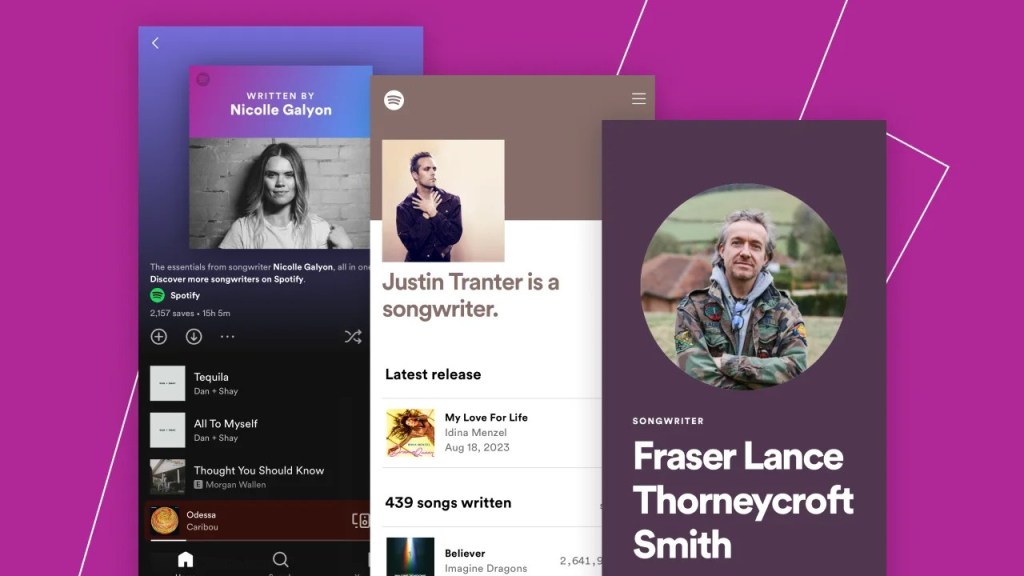
Spotify search songwriter pages clickable credits offer a unique opportunity for users to delve deeper into the creative process behind their favorite music. This feature allows users to quickly identify and explore the contributions of songwriters, potentially uncovering new artists and collaborators. The system likely utilizes a complex data structure to link songs to songwriters, facilitating the clickable experience.
Understanding the intricacies of this feature provides insight into Spotify’s commitment to transparency and user engagement.
This exploration delves into the specifics of how Spotify’s clickable songwriter credits function. We’ll examine the underlying data structures, the technical implementation, and potential improvements. Furthermore, we’ll compare Spotify’s approach to other music platforms, providing a broader perspective on this crucial aspect of music discovery. Ultimately, we aim to understand the user experience, benefits, and challenges associated with these clickable credits.
Overview of Songwriter Credit Pages on Spotify
Spotify’s search results, when focused on songwriters, offer a concise overview of the individuals behind a particular track. This page typically presents a clear and accessible way to see who contributed to the music, offering a valuable resource for fans and music professionals alike.Spotify’s songwriter credit pages present a structured format for displaying credits, aiding users in quickly identifying the individuals involved in a song’s creation.
The layout generally includes essential information such as the artist, song title, album, and the year of release. This structure is designed for straightforward comprehension and easy navigation.
Songwriter Credit Page Structure
The structure of a typical songwriter credit page is consistent across Spotify searches. Information is presented in a user-friendly format, allowing users to quickly grasp the details of a song’s authorship.
| Artist | Song | Album | Year |
|---|---|---|---|
| Taylor Swift | Shake It Off | 1989 | 2014 |
| Ed Sheeran | Shape of You | ÷ | 2017 |
| Billie Eilish | Bad Guy | When We All Fall Asleep, Where Do We Go? | 2019 |
Common Elements
The songwriter credit pages generally include the artist’s name, the specific song title, the album it appears on, and the year of release. These elements are arranged in a clear and concise manner to make the information easy to scan and understand. These pages also frequently include other details like additional songwriters, producers, or other contributors, depending on the complexity of the musical creation.
I’ve been digging into Spotify’s search function lately, and the clickable songwriter credits on artist pages are a game-changer. It’s super helpful for discovering new music and artists. You know, comparing similar features across devices is always interesting. For instance, if you’re looking to upgrade your phone, checking out the Samsung Galaxy Note 20 vs Note 10 features could be a good comparison.
samsung galaxy note 20 vs note 10 Ultimately, this attention to detail in Spotify’s search makes finding hidden gems much easier, and that’s what I love.
Consistent formatting, such as the use of a standard font and color scheme, further enhances readability.
Formatting Conventions
The formatting conventions used on Spotify’s songwriter credit pages prioritize clarity and efficiency. Information is typically presented in a straightforward manner, with a clear visual hierarchy to highlight key elements. For instance, the artist’s name might be displayed in a larger font size compared to the song title, contributing to a clear visual separation of the different pieces of information.
A consistent style guide is used to maintain a uniform presentation across all songwriter credit pages, which aids users in easily identifying and interpreting the information. This includes consistent formatting for names, song titles, and album titles, as well as using a standard font for the entire page.
Clickable Songwriter Credits Functionality
Spotify’s clickable songwriter credits provide a powerful way for users to delve deeper into the creative process behind their favorite music. This feature transforms passive listening into an active exploration, connecting listeners directly with the artists and collaborators who shaped the song. It’s a significant enhancement to the user experience, allowing for a richer understanding of musical production.This functionality unlocks a wealth of information and opportunities for engagement.
Users can quickly navigate to artist profiles, explore their discography, and discover related music. This interconnectedness fosters a deeper appreciation for the collaborative nature of music creation and encourages further exploration within the platform.
Different Interaction Methods
The clickable songwriter credits offer several interaction methods, each designed to facilitate different types of user engagement. These methods allow for a diverse approach to exploring musical credits and collaborative networks.
- Direct Navigation to Artist Profiles: Clicking on a songwriter’s name immediately takes the user to their dedicated artist profile page. This allows for a comprehensive view of the songwriter’s entire catalog, their past collaborations, and their overall artistic trajectory.
- Discovery of Related Music: The profile page often includes a curated selection of related tracks, albums, or playlists. This discovery mechanism encourages users to explore music by the same songwriter or artists with similar styles.
- Access to Song Credits on Other Platforms: Clicking a songwriter’s name may provide links to their credits on other music platforms, allowing for a wider perspective on their involvement in the music industry. This can lead to users discovering similar music or finding out more about the songwriter’s broader career.
- Exploring Collaborative Networks: Users can trace the songwriter’s collaboration history, revealing connections with other artists and composers. This can be particularly valuable for users interested in understanding the network of artists involved in a specific genre or style of music.
Potential Actions on Clicking
Upon clicking a songwriter’s name, users can perform several actions, all contributing to a more interactive and enriching experience.
- Viewing the Artist’s Profile: The user will be directed to a detailed artist page, which often includes information such as their biography, discography, social media links, and other relevant details. This empowers users to understand the context behind the songwriter’s work.
- Exploring Their Discography: The artist page typically displays a comprehensive list of their albums and tracks. This enables users to easily find and listen to other works by the same artist.
- Discovering Similar Artists: Spotify often curates a list of similar artists based on the clicked songwriter’s profile, helping users expand their musical tastes and discover new artists.
- Identifying Collaborative Partners: Clicking on a songwriter’s name might reveal collaborators on other tracks, providing insight into their working relationships and the wider creative community involved in a particular song or artist.
Impact on User Experience and Content Discovery
The clickable songwriter credits significantly enhance the user experience on Spotify by facilitating content discovery in several ways.
- Facilitating deeper exploration: Users can navigate beyond the immediate track and delve into the wider creative network surrounding it.
- Encouraging user engagement: The interactive nature of the feature motivates users to actively explore the platform, potentially leading to more listening and discovery.
- Promoting musical appreciation: Users gain a better understanding of the collaborative nature of music production, appreciating the contribution of individual songwriters.
- Increasing platform usage: The ease of access to related content encourages deeper engagement with Spotify’s ecosystem.
Comparison of Interaction Methods
| Interaction Method | Description | Potential Actions | Impact on Content Discovery |
|---|---|---|---|
| Direct Navigation | Clicking a name leads directly to the artist’s profile. | View profile, discography, related music. | Facilitates deeper exploration, broadens listening scope. |
| Related Music Discovery | Displays related tracks/albums/playlists. | Discover new music, expand musical tastes. | Promotes exploration beyond the initial song. |
| Cross-Platform Links | Provides links to credits on other platforms. | Gain broader context, explore artist’s wider career. | Enhances user understanding of artist’s overall work. |
| Collaborative Network Exploration | Reveals connections between songwriters. | Understand artistic collaborations, discover new artists. | Provides context for musical styles and genres. |
Potential Improvements and Enhancements: Spotify Search Songwriter Pages Clickable Credits
Spotify’s current songwriter credit pages, while a significant improvement, offer room for further enhancement. The clickable feature is a positive step, but more context and deeper exploration of the creative process are possible. This section explores potential improvements, including design enhancements and new features to provide a more comprehensive and engaging experience for songwriters.
Expanding Contextual Information
The current clickable feature allows for basic artist information. However, providing more granular details about the songwriter’s contribution could significantly enhance the experience. This could include specifics on the song’s genre, the instruments played, the emotional context, or even the inspiration behind the piece. For instance, knowing that a songwriter was inspired by a particular historical event could offer a unique perspective.
- Detailed song creation process: Providing a brief description of the creative process behind a song can offer insight into the songwriter’s inspiration, methodology, or even collaboration details. For example, “The song was written during a period of intense personal reflection” or “The melody was inspired by a chance encounter with a local musician.” This contextual information could personalize the experience for users and provide more value for songwriters.
- Genre-specific information: Providing details relevant to the song’s genre can help users understand the stylistic choices and influences. For example, for a jazz song, it could mention the specific jazz subgenre or the influence of a particular musician. This detailed categorization could also allow for discovery of similar musical styles.
- Instrumentation and production information: Information about the specific instruments used and production techniques could offer a deeper understanding of the song’s sound. For example, “The track was primarily recorded using vintage analog equipment” or “The song’s driving beat was created by a live drummer.” This information could attract users interested in specific production styles.
Integrating Additional Features
Expanding the songwriter credit pages beyond basic information can introduce new functionalities and enhance the platform’s value for both users and songwriters. Think of this as taking the songwriter credit page from a simple list to a dynamic hub of information.
- Interactive timelines: A visual timeline showing the song’s development stages, including songwriting, recording, and mixing, can provide a richer experience for users interested in the creative process. Imagine seeing the different stages and contributions visually displayed.
- Collaboration tools: Integrating tools that allow songwriters to connect, collaborate, and share ideas within the Spotify platform would further enhance the ecosystem and encourage further creativity.
- Music library access: Allowing users to explore similar songs or music created by the same songwriter(s) within the platform. This feature would help songwriters and fans discover more works and foster a stronger connection with the artist’s catalog.

Proposed Improvements
| Proposed Improvement | Potential Benefit |
|---|---|
| Detailed song creation process information | Provides a deeper understanding of the creative process and inspiration behind the song. |
| Genre-specific information | Enhances user experience by providing relevant context for different musical styles. |
| Interactive timelines | Offers a visual representation of the song’s development stages and collaborative efforts. |
| Collaboration tools | Facilitates connections between songwriters and encourages further creative collaboration within the platform. |
| Music library access | Promotes discovery of similar songs and the songwriter’s complete catalog. |
Comparison with Other Music Platforms
Spotify’s approach to songwriter credits is a significant step forward, but how does it stack up against other major music streaming platforms? This comparison delves into the similarities and differences in how these platforms handle the complex issue of crediting songwriters, examining their design, functionality, and the processes for identifying and acknowledging contributors. Understanding these nuances provides valuable insights into the evolving landscape of music rights management in the digital age.Different music platforms employ varying methods for displaying and managing songwriter credits.
Some prioritize a simple, straightforward approach, while others focus on comprehensive details, often including secondary contributors and additional information. The availability and accessibility of this information can significantly impact how artists and rights holders perceive and manage their contributions. This comparison aims to illustrate the spectrum of approaches and highlight areas where Spotify’s implementation excels or falls short compared to competitors.
Different Approaches to Songwriter Identification
Various platforms have adopted diverse strategies for identifying and crediting songwriters. Some rely on manually inputted data, which can be prone to errors or omissions, while others employ sophisticated algorithms and databases to automatically link songs to composers and lyricists. The accuracy and comprehensiveness of these identification methods significantly affect the reliability of the information presented to users.
Comparative Analysis of Songwriter Credit Features
| Feature | Spotify | Apple Music | Amazon Music |
|---|---|---|---|
| Songwriter Credit Visibility | Detailed credits, including primary and secondary contributors, often with links to artist pages | Generally comprehensive, but potentially less detailed than Spotify, depending on the specific song | Credits are often visible, but less detailed than Spotify or Apple Music; sometimes limited to primary contributors |
| Clickable Songwriter Credits | Yes, enabling users to navigate to songwriter profiles and view more information | Partially, clickable links to artist profiles for some, but not all songwriters | Limited or no clickable songwriter credits, relying primarily on text-based listings |
| Database of Songwriters | Potentially comprehensive database, facilitating accurate identification and linking | Likely a large database, but the extent of detail and coverage may vary | Probably a database, but the scope and depth might differ, impacting identification accuracy |
| Secondary Contributor Credits | Typically displays secondary contributors like arrangers, producers, etc. | Usually includes secondary contributors but may not be as extensive as Spotify’s | Usually limited to primary contributors, less emphasis on secondary roles |
Spotify, through its clickable credits and detailed songwriter profiles, aims to enhance transparency and user engagement. This feature not only benefits users interested in the creative process but also supports the songwriter community by providing a direct link to their work. Apple Music and Amazon Music, while displaying credits, might not provide the same level of detail or interactive elements.
The lack of clickable links can limit user exploration and access to deeper information about the creative process behind a song.
Technical Aspects of Implementation
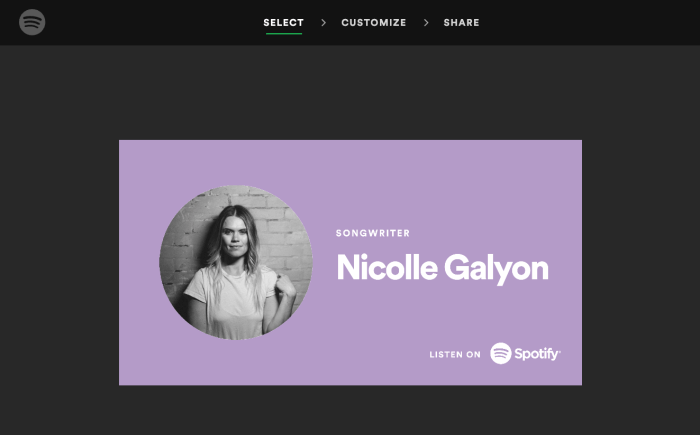
Spotify’s clickable songwriter credits represent a significant technical undertaking, requiring a robust system for data management, retrieval, and display. This intricate system needs to be scalable to accommodate a massive amount of musical data and user requests while maintaining high performance and accuracy. The technical considerations involved in building and maintaining such a feature are multifaceted and demand careful planning and execution.
Data Storage and Retrieval
The core of the clickable credits functionality lies in efficiently storing and retrieving songwriter information. This involves a complex database structure capable of holding vast amounts of metadata associated with songs, including the names and affiliations of songwriters, as well as the associated tracks, albums, and artists. Relational database management systems (RDBMS) are likely employed to link these diverse data points.
For example, a table might store songwriter information (name, ID, etc.), while another table holds song details (song ID, artist ID, songwriter ID, etc.). Querying these databases to quickly retrieve the correct songwriter information for a given song is a crucial aspect of the implementation. This process relies heavily on optimized database queries and potentially indexing strategies to achieve fast response times.
API Integration and Data Synchronization
Spotify’s system must seamlessly integrate with various internal and external APIs to maintain accuracy and up-to-date information. This includes APIs for music metadata, artist information, and potentially copyright databases. The system needs robust error handling and synchronization mechanisms to manage potential data discrepancies or changes in the underlying datasets. For example, if a songwriter’s name changes, the system must be able to update this information across all relevant songs and associated data.
Frontend Development and User Experience
The frontend implementation is critical to delivering a smooth and intuitive user experience. This likely involves using JavaScript frameworks like React or Angular, along with CSS frameworks for styling and layout. The architecture needs to be designed to handle dynamic updates in response to user actions, such as clicking on a songwriter’s name. The system also requires thorough testing to ensure the accuracy and consistency of the data displayed and the overall user interface.
A critical component is the rendering of the credit list to be displayed alongside the song information. This often involves a component-based architecture to modularize and reuse code.
Security Measures
Robust security measures are paramount to protect sensitive data, including intellectual property rights and user information. Spotify likely employs encryption for data in transit and at rest. Access control mechanisms ensure only authorized personnel can modify or access the database. Auditing and logging mechanisms track all actions on the system to detect and respond to potential security breaches.
This is vital for maintaining the integrity of the system and compliance with legal requirements. The system needs to prevent unauthorized access and data manipulation to protect the intellectual property rights of songwriters.
User Experience Considerations
Clickable songwriter credits on Spotify’s search pages offer a valuable tool for music enthusiasts. Understanding how users interact with these credits is crucial for improving their engagement and overall satisfaction with the platform. A well-designed system should allow users to easily discover and explore the contributions of various songwriters, ultimately enriching their experience of music discovery.The design of these songwriter credit pages directly impacts user engagement and satisfaction.
Ever wondered how Spotify’s search function handles songwriter credits? The clickable links on those songwriter pages are pretty cool, right? It’s a great way to discover new music and artists. This kind of intuitive design is similar to the meticulous approach in ps ee ee plus security operations prisma sd wan , where the security features are as clearly defined as those songwriter credits.
Hopefully, Spotify will continue to enhance this feature, making it even more useful for music discovery.
A clear, intuitive layout is paramount for easy navigation and comprehension of the information presented. The effectiveness of this feature hinges on how easily users can access and interpret songwriter credits, which should be presented in a way that fosters a deeper connection with the creative process behind their favorite music.
Ever noticed how Spotify’s search for songwriter pages often has clickable credits? It’s a cool feature, but it’s a shame that other music platforms haven’t followed suit. Maybe they’re busy with things like T-Mobile adding new travel perks in their latest carrier move here. Either way, those clickable credits on Spotify are a great way to easily dig into the musicians behind the music.
I wish more music platforms would adopt similar design choices.
Impact on User Engagement
User engagement with clickable songwriter credits is influenced by the ease of finding and understanding the information presented. A well-structured page design promotes exploration and discovery. If the credits are difficult to find or the information is confusing, users may be less likely to delve into the details of each songwriter’s work.
Design Elements Affecting Satisfaction
Several design elements directly affect user satisfaction. The visual clarity of the songwriter credit section, including the font size, color scheme, and use of whitespace, is essential. A user-friendly interface, enabling easy access to relevant information, significantly contributes to a positive user experience. Properly implemented visual cues and clear information hierarchy are critical to ensure that users can quickly grasp the presented details.
Potential User Feedback and Issues
User feedback on clickable songwriter credits can highlight potential issues. One common concern might be the lack of context provided with the credit. For instance, a user might want to understand the songwriter’s style or other projects they have been involved in. Providing links to related songs or artists would be beneficial. Also, excessive information overload on the page can be overwhelming, hindering user comprehension.
User-Centered Design Principles
User-centered design principles are vital for the successful implementation of this feature. These principles emphasize understanding user needs and behaviors. A strong emphasis on clarity, conciseness, and visual appeal in the presentation of songwriter credits is crucial. The design should accommodate various user preferences and learning styles, ensuring accessibility for all.
Example of a Well-Designed Credit Page, Spotify search songwriter pages clickable credits
A well-designed songwriter credit page would clearly display the songwriter’s name, the songs they contributed to, and links to other related artists or albums. A thumbnail of the song’s album cover could be included. Furthermore, a brief description of the songwriter’s background or style could be provided. This additional information would enhance the user’s understanding and potentially lead to further exploration within the platform.
Examples of Different Songwriter Credit Structures
Songwriting credits are more than just names; they’re a crucial part of the music industry’s ecosystem, reflecting the collaborative nature of creation. Understanding the varying structures used across genres is key to appreciating the diverse contributions behind a song. Different genres often employ unique credit structures, reflecting the specific roles and contributions of the individuals involved.
Pop Music Credit Structures
Pop music, often characterized by its commercial appeal, frequently involves multiple songwriters contributing to the creation of a track. The credit structure often reflects a balance between the primary songwriter(s) who conceived the core melody and lyrical ideas and the additional collaborators who provided instrumental arrangements or significant contributions to the final product.
- Lead Songwriters: Often the composers of the primary melody and lyrics. They might have the majority of the credit, or even sole credit in some cases, if their contribution is considered the core idea.
- Additional Songwriters: These songwriters may have contributed to elements like harmonies, additional verses, or instrumental parts, which are not considered core to the composition but essential to the final product.
- Producers: Producers, even if they don’t write the music, are often credited, especially in the pop realm, for their contribution to the final sound and arrangement of the song. They might also have a hand in the creation of the musical elements.
Classical Music Credit Structures
Classical music often emphasizes the composer as the primary creative force. The credit structure typically reflects the composer’s original creation, and other credits are for performing arrangements, specific instruments, or artistic direction.
- Composer: The individual who created the original composition, including melody, harmony, and structure. This is the most prominent credit.
- Arranger: This credit is often given to someone who has adapted the composer’s original work for a different instrumentation or ensemble.
- Orchestrator: This credit is specific to orchestral works and indicates the person responsible for arranging the parts for the various instruments in the orchestra.
Jazz Music Credit Structures
Jazz music often involves improvisation and collaboration, leading to a slightly different approach to crediting songwriters. The structure frequently recognizes the composer of the original tune, as well as the individual instrumentalists who created their own improvisational solos.
- Composer: The creator of the original melody and harmony for the song.
- Soloists: In jazz, the contributions of instrumentalists who improvise are significant and are often individually recognized, even if the underlying tune is pre-composed.
- Arrangers: If the music has been adapted or arranged, the arranger may receive credit.
Table of Examples
| Genre | Typical Credits | Example |
|---|---|---|
| Pop | Lead Songwriter, Additional Songwriters, Producer | Taylor Swift (Lead), Jack Antonoff (Additional), Taylor Swift (Producer) |
| Classical | Composer, Arranger, Orchestrator | Ludwig van Beethoven (Composer), (Arranger), (Orchestrator) |
| Jazz | Composer, Soloist, Arranger | Duke Ellington (Composer), John Coltrane (Soloist), (Arranger) |
Ending Remarks
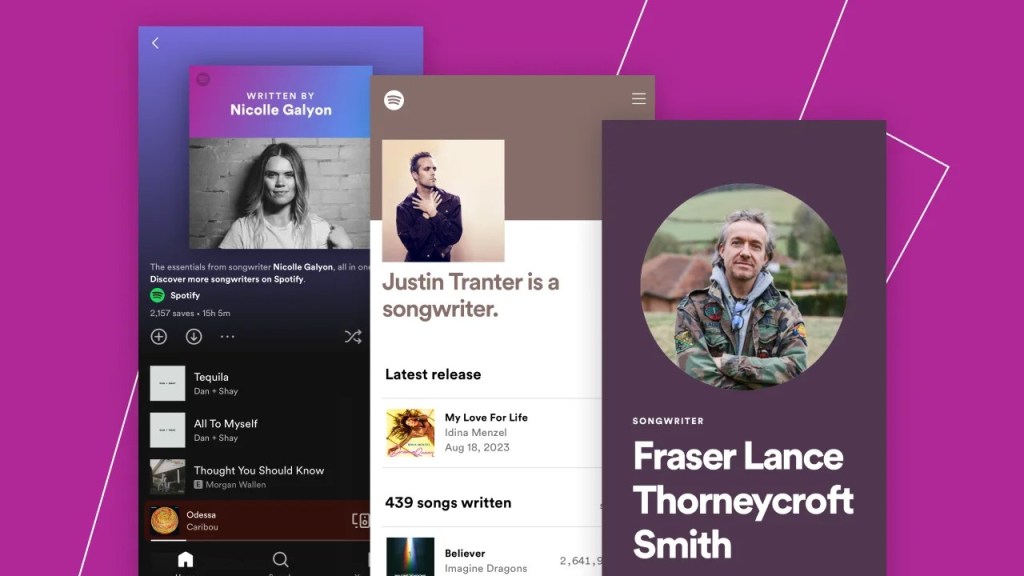
In conclusion, Spotify’s clickable songwriter credits represent a significant step forward in enhancing user experience and transparency within the music streaming platform. The feature, driven by a robust data structure and user-centered design, fosters deeper engagement with music creation. While the current implementation is commendable, potential improvements and enhancements exist, paving the way for an even richer experience in the future.
Comparisons with other platforms underscore Spotify’s innovative approach and position within the music industry.