



Brave search engine apply custom rankings filters goggles opens up a world of personalized search experiences. Imagine tailoring your search results to your specific needs, not just relying on broad matches. This exploration dives deep into Brave Search’s unique features, showing how custom rankings and filters, integrated with the Goggles feature, revolutionize the way we navigate the digital landscape.
We’ll cover the history, functionality, and user experience, along with comparisons to other search engines, ultimately showcasing the potential of this powerful tool.
This in-depth look at Brave Search’s customizability delves into the technical aspects, including how custom rankings are applied, various filter types, and integration with Goggles. We’ll examine real-world examples, best practices, and potential limitations, offering a comprehensive understanding for users seeking to master their search results.
Introduction to Brave Search Engine
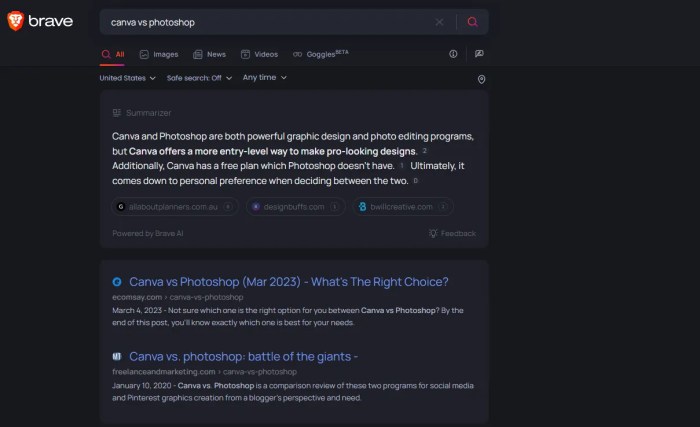
Brave Search is a privacy-focused search engine designed to offer a more user-friendly and secure alternative to traditional search engines. It prioritizes user privacy by not tracking search history or collecting personal data. This focus on privacy is a key differentiator in the increasingly digital world where data collection practices are a concern for many users.Brave Search employs a unique approach to indexing and ranking search results.
This approach aims to provide users with more relevant and trustworthy results while upholding the user’s right to privacy. The engine utilizes a combination of AI and human curation to improve search accuracy and reliability.
Core Functionality of Brave Search
Brave Search functions as a standard search engine, allowing users to input s and receive a list of relevant results. Crucially, it prioritizes privacy and data security. The search engine does not collect user data, thereby protecting user information.
I’ve been digging into Brave’s new search engine features, and the ability to apply custom ranking filters and goggles is pretty cool. It’s fascinating how this functionality relates to broader discussions around intellectual property, like the recent ruling on the gene editing tool CRISPR, a technology with a lot of potential. This recent dispute involving Broad Institute, MIT, and UCB over patent rights for CRISPR ( gene editing tool crispr broad mit ucb patent dispute ruling ) highlights the complexities of innovation and intellectual property.
Ultimately, I’m excited to see how these Brave search features evolve and how they might impact how we access and evaluate information.
Unique Features of Brave Search
Brave Search offers a range of unique features designed to enhance the user experience and promote user privacy. These features include:
- Privacy-focused design: Brave Search does not track user search history or collect personal data, safeguarding user privacy.
- Fast search results: Brave Search utilizes advanced indexing and ranking algorithms to deliver quick and relevant results. This speed is a significant improvement over many competing search engines.
- Integrations with other Brave products: Brave Search seamlessly integrates with other Brave products, creating a unified experience for users.
- Support for various languages: Brave Search supports a wide array of languages, making it accessible to a global user base.
User Experience with Brave Search
The user experience of Brave Search is characterized by its simplicity and intuitive interface. Users can easily navigate the search results and find the information they need. The clean design and fast loading times contribute to a positive user experience.
History and Evolution of Brave Search
Brave Search’s development reflects a growing trend towards privacy-focused search engines. The engine evolved from the core principles of the broader Brave browser project, emphasizing security and user control over personal data. The search engine has been continuously updated and improved over time to enhance its functionality and performance.
Process of Searching on Brave Search
The process of searching on Brave Search is straightforward. Users input their search query into the search bar, and Brave Search returns a list of relevant results. The results are presented in a clear and concise format, making it easy for users to quickly locate the information they need. This straightforward process is a key aspect of the overall positive user experience.
Custom Rankings and Filters
Brave Search’s innovative approach to search results goes beyond simple matching. It empowers users with customizable rankings and filters, allowing for a more tailored and efficient search experience. This feature set significantly enhances the search experience by prioritizing relevant and trustworthy results. Users can now actively shape the search landscape to align with their specific needs.
Customizable Ranking Criteria
Brave Search offers a variety of ranking criteria that users can adjust to prioritize certain types of results. These criteria can be combined to create highly specific search profiles. For example, a user might want to favor news articles from reputable sources over blog posts. This customization empowers users to control the prominence of different content types in their search results.
Brave Search’s flexible approach allows users to effectively filter out irrelevant results, ensuring that only the most relevant and reliable information is displayed.
Diverse Filtering Options
Brave Search provides a wide range of filters to refine search results. These filters cater to various user needs and preferences, enabling a more precise and focused search experience. They allow users to control the types of content that appear in their search results. This customization is valuable for various tasks, from finding specific types of information to excluding unwanted content.
Brave’s search engine is cool, letting you customize rankings and filters with goggles. It’s fascinating how this affects your search experience, especially when you consider how easily misinformation spreads, like during the 2020 election when fact-checking was crucial. For example, exploring the Twitter controversies surrounding Donald Trump’s claims about mail-in voting, the coronavirus pandemic, and California’s response twitter donald trump fact check mail in voting coronavirus pandemic california highlights the importance of reliable sources.
Ultimately, these customizable search features in Brave help you find verified information, making the entire search process much more trustworthy and useful.
Filters are applied to the search results to refine the displayed information.
Example Filter Functionality
One prominent filter type is the ability to prioritize results from specific sources. For instance, a user might want to see results only from academic journals or government websites. Another example is the ability to exclude results containing certain s. This allows users to eliminate unwanted content and focus on more relevant information. Additionally, users can filter results by date, language, or document type.
For instance, searching for “stock market trends” might show results filtered by date, ensuring that the most recent information is prominent.
Comparison of Filtering Options
Different filters have distinct impacts on search results. Filtering by date ensures that the most recent information is prioritized, while filtering by source ensures that the results come from credible and trustworthy sources. Filtering by language restricts the results to a particular language, which is essential for users who need information in a specific language. Each filter is designed to narrow the scope of the search results in a specific manner.
Best Practices for Custom Rankings and Filters
To effectively utilize custom rankings and filters, users should understand the different criteria and how they interact. By understanding the available filters and their impact on results, users can create custom rankings that precisely meet their needs. Experimenting with different combinations of filters can yield valuable insights and improve the search experience.
Table of Available Filters
| Filter Name | Description | Example Usage | Impact on Results |
|---|---|---|---|
| Source | Prioritizes results from specific sources. | Filtering for results from .gov or .edu domains. | Displays results from specified sources, potentially excluding others. |
| Date | Filters results by publication date. | Showing only results published within the last year. | Prioritizes or excludes results based on their age. |
| Language | Restricts results to a particular language. | Searching for articles in French. | Displays results in the selected language only. |
| Document Type | Filters results based on the document format. | Finding PDFs related to a specific topic. | Shows results in the desired document format. |
| Exclusion | Removes results containing specific s. | Searching for “coffee” while excluding “tea”. | Removes unwanted s from search results. |
Integration with Goggles
Brave Search’s integration with Goggles promises a more intuitive and targeted search experience. By leveraging the power of Goggles’ visual and interactive elements, users can delve deeper into search results and uncover insights that traditional text-based searches might miss. This powerful combination offers a unique approach to information retrieval, moving beyond simple matching to a more holistic understanding of the search intent.
Enhancing the Search Experience with Goggles
Goggles, with its visual interface, allows users to explore search results in a richer, more interactive way. Instead of just presenting a list of links, Goggles can display images, maps, charts, and other visual representations directly within the search results page. This visual context enhances comprehension and provides a more immediate understanding of the information presented. Users can quickly identify key data points and patterns, leading to a more efficient and satisfying search experience.
Refining Searches with Goggles
Goggles offers various ways to refine searches beyond basic adjustments. Users can zoom in on specific areas of an image, manipulate interactive maps, or filter data within charts to extract precise information. This granular level of control empowers users to delve deeper into search results, uncovering nuanced details and hidden connections. This interactive approach goes beyond simple matching, providing a more nuanced understanding of the information presented.
For instance, a user searching for “best hiking trails near Yosemite” might use Goggles to zoom in on a trail map to identify specific elevation profiles or nearby campsites.
Potential Limitations of Goggles
While Goggles significantly enhances the search experience, potential limitations exist. The effectiveness of Goggles depends heavily on the availability of visual data associated with the search query. If the relevant data isn’t readily available or formatted for interactive display, the benefit of Goggles diminishes. Moreover, the complexity of some search queries might overwhelm the visual representation, potentially obscuring the relevant information.
Lastly, the loading speed and responsiveness of Goggles are crucial; slow loading times could lead to frustration and hinder the user experience.
Workflow for Complex Searches
A complex search leveraging Goggles would involve these steps:
- Formulating the initial search query using s relevant to the desired outcome.
- Using Goggles to explore visual elements within the search results. For example, a user searching for “historical population growth in Europe” might use interactive maps to pinpoint specific regions and periods.
- Refining the search by interacting with visual elements, such as zooming in on specific regions on a map, or filtering data within a chart.
- Extracting precise data points and insights from the interactive visualizations.
This detailed workflow ensures a more targeted and comprehensive approach to information retrieval, particularly when dealing with complex queries.
Common Queries Benefiting from Goggles
Goggles are particularly helpful for searches involving visual data, geographic information, or statistical analysis. Here are some examples:
- Comparing population density in different cities: Users can use interactive maps to visualize population density and identify trends across various urban areas.
- Analyzing historical stock market trends: Charts and graphs can help users identify patterns and fluctuations in the market over time.
- Understanding the architectural styles of different buildings: Users can use interactive images to explore architectural features and identify similarities and differences between various styles.
- Determining the nutritional content of foods: Visual representations of food labels, including nutrition charts, can provide quick access to detailed nutritional information.

These queries benefit significantly from Goggles’ ability to present and manipulate visual data, offering a more engaging and insightful search experience.
User Perspective on Customizations: Brave Search Engine Apply Custom Rankings Filters Goggles
Brave Search’s ability to personalize search results through custom rankings and filters is a significant step toward a more user-centric approach. Understanding the user’s perspective on these features is crucial for optimizing the search experience and ensuring widespread adoption. This section delves into user satisfaction, pain points, and the overall impact of these customizations on the user journey.Implementing custom rankings and filters requires a thoughtful consideration of user needs and preferences.
Ever wanted to fine-tune your Brave search engine results? Applying custom ranking filters and goggles can be a game-changer, but securing your infrastructure is equally critical. A solid guide to operationalizing your IAC security program, like the one offered by Skyport Systems guide to operationalizing your iac security program , will help you understand the importance of robust security practices.
Ultimately, a well-protected system allows you to truly maximize the benefits of those custom Brave search filters.
A well-designed system will empower users to tailor their search experience, leading to improved efficiency and satisfaction. Conversely, a poorly designed system could lead to confusion and frustration, hindering the user experience.
User Satisfaction with Custom Filters
Custom filters, designed to refine search results based on user preferences, hold the potential to significantly improve the user experience. However, effective implementation requires a user-friendly interface and intuitive options. A cluttered or confusing filter system can quickly frustrate users, leading to a negative perception of the search engine. Well-designed filters, on the other hand, can empower users to quickly isolate relevant information, improving their efficiency and satisfaction.
Potential User Pain Points in Using Custom Filters
Users might encounter difficulties if the filter options are not clearly presented or if the results are not as expected. Confusing filter interactions, a lack of clear documentation, or unexpected outcomes can create user frustration. For instance, a user may struggle to find a specific combination of filters to achieve the desired results. Furthermore, if filters don’t accurately reflect the user’s search intent, the user might experience disappointment and reduced satisfaction.
Impact of Custom Rankings on User Experience
Custom rankings, allowing users to prioritize specific search results, can enhance the user experience. Users can refine the order of results to reflect their priorities, thereby directing their attention to the most relevant information. However, an overly complex or inflexible ranking system could lead to difficulty in achieving desired outcomes, hindering the user experience. For example, users might struggle to adjust the ranking to their specific needs if the available options are limited or not well-explained.
User Feedback on Custom Rankings and Filters
User feedback on custom rankings and filters can range from enthusiastic praise to constructive criticism. Some users might find the features invaluable, allowing them to quickly zero in on the information they need. Others might express concerns about the complexity or lack of intuitive controls. Early user feedback, gathered through various channels, is essential for identifying and addressing any issues with the implementation.
Comparison of User Satisfaction Levels
| Feature | High Satisfaction | Medium Satisfaction | Low Satisfaction |
|---|---|---|---|
| Standard Search (No Customizations) | High | Medium | Low |
| Custom Rankings Enabled | Moderate | High | Low (due to complexity) |
| Custom Filters Enabled | High | Moderate | Low (due to filter interaction issues) |
Comparison with Other Search Engines
Brave Search aims to differentiate itself from established search engines like Google, DuckDuckGo, and Bing by prioritizing user control over search results. This control, manifested through custom rankings and filters, sets it apart in a market often dominated by algorithms and pre-defined result presentations. This comparison explores how Brave Search’s approach stacks up against the competition.Brave Search distinguishes itself from traditional search engines by offering a degree of user customization not often seen.
By allowing users to define their preferred search ranking and filtering criteria, Brave Search attempts to tailor results to the individual’s needs and preferences, rather than relying solely on the often opaque algorithms of competitors. This personalization allows for a more targeted search experience, potentially improving the relevance and utility of search results.
Custom Ranking Feature Comparison
Brave Search’s custom ranking features enable users to prioritize specific search result characteristics, like recency, relevance, and source authority. This contrasts with Google, Bing, and DuckDuckGo, where the default ranking is primarily based on factors like page popularity and algorithm-determined relevance. Google, for instance, uses a complex algorithm to rank results, which is not easily modifiable by the user.
DuckDuckGo also utilizes its own algorithm, but with limited user-defined ranking parameters. Bing’s ranking system also relies on a proprietary algorithm.
Filter Feature Comparison
Brave Search’s filters provide granular control over search results, allowing users to exclude certain content types, sources, or even languages. This level of control is a notable difference from other search engines. Google, while offering some filtering options, such as safe search, lacks the comprehensive filtering options provided by Brave Search. DuckDuckGo provides some filtering features, but they are less nuanced than those offered by Brave Search.
Bing, too, has filtering options, but they are less customizable than Brave Search’s.
User Experience in Customizations
Brave Search aims to create a user-friendly interface for applying custom rankings and filters. The intuitive design should allow users to quickly and easily modify their search preferences. Google’s interface, while robust, might be perceived as less user-friendly for those unfamiliar with its complex search operators. DuckDuckGo prioritizes simplicity, which can be both a strength and a weakness in terms of customization.
Bing’s interface for custom rankings and filters might be less accessible than Brave Search’s.
Competitive Landscape Analysis
The competitive landscape for search engines with custom ranking and filtering options is still nascent. While other search engines offer some degree of customization, Brave Search distinguishes itself by offering a more comprehensive and intuitive approach to user-controlled search results. This could lead to increased user engagement and satisfaction, especially for users who demand greater control over their search experience.
Comparative Table
| Search Engine | Custom Ranking | Filters | User Experience |
|---|---|---|---|
| Brave Search | User-defined priorities for recency, relevance, and authority. | Comprehensive filtering options for content type, source, and language. | Intuitive interface for easy customization. |
| Limited user control; relies on complex algorithm. | Basic filtering options (e.g., safe search). | Robust but potentially overwhelming interface for customization. | |
| DuckDuckGo | Limited user control over ranking parameters. | Basic filtering options. | Simple interface, but less flexibility. |
| Bing | Limited user control; relies on proprietary algorithm. | Filtering options available, but less customizable than Brave Search. | Interface for customization potentially less accessible. |
Advanced Search Techniques
Brave Search’s custom rankings and filters open up exciting possibilities for advanced search techniques. Beyond simple searches, users can now refine results with precision, targeting specific information and sources. This allows for a more focused and efficient exploration of the vast online landscape. By leveraging these advanced tools, users can move beyond basic queries to uncover deeper insights and richer understanding.
Combining Filters for Precision
Custom filters are not limited to individual use; they can be combined for intricate searches. For example, a user might want articles published within the last year, categorized as “technology,” and authored by a specific expert. By layering these filters, the search engine can deliver a highly curated set of results, significantly reducing the noise and irrelevant information typically found in broad searches.
This refined approach dramatically improves the quality and relevance of the search results.
Advanced Search Operators
Brave Search incorporates advanced search operators, enabling more nuanced queries. These operators, combined with filters, allow users to specify the type of information they seek. For example, using quotation marks around a phrase (“quantum entanglement”) ensures the search engine returns results containing that precise phrase, while the “filetype:pdf” operator can restrict results to PDF documents. This capability greatly enhances search accuracy and efficiency, delivering results tailored to the specific needs of the user.
Illustrative Examples of Advanced Searches
To illustrate, consider these examples:
- To find scholarly articles on “AI ethics” published in the last five years, filtered by authors with expertise in machine learning, one could use a combination of s, time-based filters, author expertise filters, and potentially filetype filters.
- To locate recent news articles about “cryptocurrency regulations” from reputable sources, users can apply filters for publication date, source reliability, and relevance. The search could also incorporate location-based filters, further refining the results to a geographically focused set of results.
- To identify and compare different policies on “climate change” from various countries, one can combine searches, location-based filters, and document type filters to pinpoint relevant policy documents from specific countries.
Impact on Search Result Quality, Brave search engine apply custom rankings filters goggles
Advanced search techniques with custom filters dramatically enhance the quality of search results. By combining precise s with targeted filters, users significantly reduce the volume of irrelevant information, leading to more focused and actionable results. The result is a marked improvement in user experience, enabling them to quickly locate the specific information they need.
“The most effective advanced search strategies involve a combination of precise s, relevant filters, and advanced search operators. This targeted approach minimizes irrelevant results and significantly improves the quality and efficiency of the search process.”
Final Wrap-Up
In conclusion, Brave Search’s custom ranking and filter features, when combined with the Goggles integration, present a significant advancement in search engine technology. This detailed analysis reveals the potential for a truly personalized and efficient search experience. We’ve explored the features, practical applications, and user perspectives, ultimately highlighting the strengths and weaknesses compared to other popular search engines.
The potential for advanced search techniques and tailored results is immense, making Brave Search a compelling option for users seeking more control over their online discovery.