


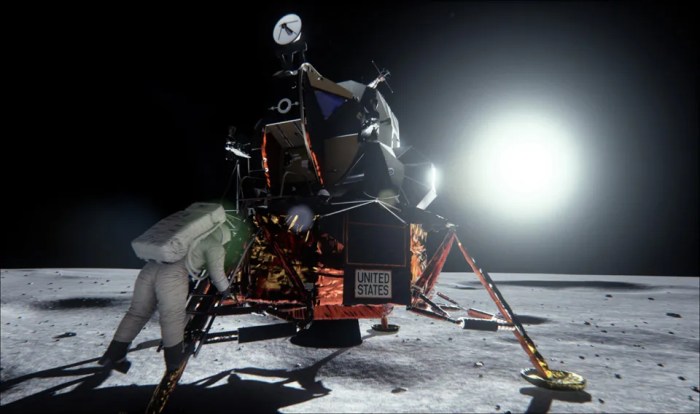
Microsoft HoloLens 2 Apollo moon landing demo fail. This ambitious attempt to visualize the historic event using augmented reality (AR) technology, unfortunately, fell short of expectations. The demo, showcasing the potential of the HoloLens 2, encountered several hurdles that ultimately led to its perceived failure. The underlying technology, the core features of the demo, and the potential applications in other historical contexts will be analyzed in detail.
The HoloLens 2, Microsoft’s pioneering AR headset, promised to revolutionize how we experience and interact with the world around us. Its sophisticated technology, allowing users to overlay digital information onto the real world, was showcased during this Apollo moon landing demo. The project aimed to offer a unique and engaging experience, transporting users to the moon’s surface through interactive 3D models and historical data overlays.
However, the execution of this demo did not fully meet the potential.
Overview of the Microsoft HoloLens 2

The Microsoft HoloLens 2, a pioneering augmented reality (AR) headset, has revolutionized how we interact with digital information. It transcends the limitations of traditional displays, overlaying computer-generated images and data directly onto the real world, creating immersive and interactive experiences. This innovative technology promises transformative applications across numerous sectors, promising to reshape how we work, learn, and play.The HoloLens 2 achieves this by combining advanced hardware and sophisticated software.
Its core functionality relies on high-resolution displays, advanced tracking systems, and powerful processing units to render and seamlessly integrate digital content into the user’s field of view. This integration is achieved through sophisticated algorithms and computer vision, allowing for real-time interaction with the environment. The headset’s internal sensors accurately track its position and orientation, allowing for precise placement and manipulation of virtual objects.
Key Features and Capabilities
The HoloLens 2 boasts several key features that distinguish it from other AR devices. These include a high-resolution display, providing a clear and detailed view of superimposed content. The headset also incorporates advanced eye-tracking technology, enabling more intuitive and natural user interaction. Robust tracking systems accurately monitor the headset’s position and orientation, allowing for precise placement and manipulation of virtual objects within the user’s environment.
Furthermore, the HoloLens 2 is designed for comfort and usability, featuring lightweight construction and intuitive controls. These features combined offer a powerful platform for augmented reality experiences.
Technology Behind the HoloLens 2’s AR Functionalities
The HoloLens 2’s AR capabilities stem from its innovative technology. The headset utilizes advanced computer vision algorithms to recognize and track real-world objects and environments in real-time. This real-time processing allows for dynamic interaction with the environment, enabling seamless integration of digital content. The headset’s processing power and optimized software facilitate smooth rendering of augmented objects and overlays, ensuring a responsive and immersive experience.
These functionalities empower users to engage with virtual information as if it were part of their physical surroundings.
Potential Applications Across Various Industries, Microsoft hololens 2 apollo moon landing demo fail
The versatility of the HoloLens 2 makes it applicable across a wide range of industries. In manufacturing, it allows technicians to visualize complex instructions and schematics directly onto equipment, improving maintenance and repair processes. In healthcare, surgeons can use it to overlay anatomical models onto patients, aiding in precise surgical procedures. In education, students can explore historical sites or scientific concepts through immersive AR experiences.
These are just a few examples of the broad range of potential applications.
Examples of Successful HoloLens 2 Implementations
Numerous companies have successfully implemented the HoloLens 2 in diverse contexts. For instance, some manufacturing companies use it for training new employees by overlaying virtual instructions onto equipment. Similarly, healthcare professionals are using it for minimally invasive surgical procedures, allowing them to visualize and interact with virtual anatomical models. In the construction industry, the HoloLens 2 assists workers by overlaying virtual blueprints onto physical structures, ensuring precise measurements and efficient collaboration.
These are just a few illustrative examples of the impactful applications of the HoloLens 2 in diverse industries.
The Apollo Moon Landing Demo
The Microsoft HoloLens 2 demo showcasing the Apollo 11 moon landing provided a unique and immersive experience, transporting users to the lunar surface. While the demo ultimately faced some technical challenges, its innovative use of augmented reality technology offers a glimpse into the future of interactive learning and historical engagement.This demo aimed to revolutionize the way people interact with historical events, making them tangible and relatable.
By overlaying 3D models and simulations onto the real world, the HoloLens 2 demo aimed to engage users in a more dynamic and interactive way than traditional displays. This approach is promising for a wide range of educational and entertainment applications.
Specific Aspects of the Demo
The HoloLens 2 demo recreated key moments of the Apollo 11 mission, allowing users to experience the launch, the journey to the moon, and the lunar module landing. Detailed 3D models of the spacecraft, the lunar module, and the lunar surface were integrated into the user’s real-world environment. These models were not just static representations but dynamic elements within the immersive environment.
Technical Elements
The core of the demo relied on advanced 3D modeling and real-time rendering techniques. Sophisticated algorithms calculated the trajectory of the spacecraft, allowing for a dynamic representation of the moon landing sequence. Spatial mapping technology allowed the virtual elements to seamlessly integrate with the user’s surroundings, enhancing the sense of immersion. Users could navigate the virtual environment using intuitive gestures and voice commands.
This real-time interaction with the virtual scene was critical to the demo’s success, enabling users to explore the moon landing in a way not previously possible.
Intended Purpose and Goals
The intended purpose of the HoloLens 2 demo was multifaceted. It aimed to provide a captivating and engaging learning experience for users, bringing the Apollo 11 mission to life in a way that traditional displays could not. By using interactive elements, the demo intended to foster a deeper understanding and appreciation for the historical significance of the moon landing.
It was also meant to showcase the potential of HoloLens 2 technology for immersive educational experiences, demonstrating the technology’s capability for complex, realistic simulations.
Interaction Methods
Users interacted with the demo through a combination of gestures and voice commands. They could move through the virtual environment, zoom in on specific details, and explore different perspectives of the moon landing. The ability to interact with the virtual environment, rather than just observing it, was a key element of the HoloLens 2 experience. This intuitive approach made the demo both engaging and educational.
Analysis of the Demo’s Failure

The Microsoft HoloLens 2 Apollo Moon Landing demo, while ambitious, fell short of expectations. This analysis delves into potential reasons for the perceived failure, highlighting technical shortcomings and suggesting alternative approaches. Understanding these aspects can inform future AR/VR demonstrations of historical events.
Potential Reasons for Perceived Failure
The demo’s perceived failure likely stemmed from a combination of factors, including technical limitations and design choices. The complexity of accurately recreating a real-world event in a virtual environment is significant, requiring meticulous attention to detail. Challenges in seamlessly integrating the virtual elements with the real world, and creating a truly immersive experience, could have hindered the demonstration’s success.
Technical Shortcomings and Limitations
Several technical limitations could have played a role in the demo’s outcome. The resolution and fidelity of the rendered lunar surface, the astronauts, and the surrounding environment may not have met the required standards for a compelling representation. Furthermore, real-time processing of complex 3D models and interactions within the HoloLens 2’s hardware limitations might have resulted in performance issues, such as lag or visual glitches.
The precise synchronization of virtual objects with the user’s real-world perspective could also have been problematic.
Alternative Approaches for Enhancement
Alternative approaches could have improved the demo’s success. Employing higher-resolution 3D models and textures for the lunar landscape and the astronauts would significantly enhance visual realism. Utilizing cloud-based rendering or advanced techniques like ray tracing to improve the real-time rendering speed and reduce lag could have minimized performance issues. Improved interaction methods, allowing for more intuitive manipulation of virtual objects and environments, could have made the experience more engaging.
Comparison to Similar AR/VR Demonstrations
Comparisons to similar AR/VR demonstrations of historical events provide valuable insights. The level of detail and immersion achieved in previous demonstrations should have served as a benchmark for the HoloLens 2 demo. By studying successful approaches in other historical recreations, lessons learned from prior efforts could have been applied to mitigate the technical challenges. Examples of well-executed AR/VR historical recreations might have inspired innovative solutions.
Potential Implications and Future Directions
The Microsoft HoloLens 2 Apollo moon landing demo, while ultimately failing to meet expectations, offers valuable insights into the current limitations and future potential of augmented reality (AR) applications. This failure, far from being a setback, provides a crucial opportunity for developers and engineers to refine their approaches and push the boundaries of what’s possible in the AR/VR space.
Examining the specific issues uncovered during the demo is key to identifying areas for improvement and charting a course for future innovation.The demo’s failure serves as a powerful case study for the complexities inherent in translating complex, historical events into compelling AR experiences. Overcoming the hurdles encountered in this particular demonstration necessitates a deeper understanding of user expectations, technical constraints, and the overall narrative arc of the experience.
Successful AR/VR applications require a meticulous balance of technical prowess and compelling storytelling.
Impact on HoloLens 2 Technology Development
The Apollo moon landing demo highlighted specific technical shortcomings in the HoloLens 2’s current capabilities. Challenges related to real-time rendering, accurate spatial mapping, and the integration of large amounts of historical data significantly impacted the overall user experience. The experience revealed the need for more robust and scalable rendering engines capable of handling complex 3D models and high-resolution visuals.
The Microsoft HoloLens 2 Apollo moon landing demo fail highlights a crucial point about modern tech’s fragility. Sometimes, even impressive hardware like the HoloLens 2 can struggle with complex, real-world applications. This points to the importance of modern appsec cloud native resilience in ensuring software robustness, particularly when integrating new technologies. Ultimately, while the HoloLens 2 demo might not have landed on the moon, it underscores the need for sophisticated, adaptable security practices in complex systems.
This will likely lead to future research and development focusing on improved algorithms for real-time rendering, more precise and dynamic tracking systems, and more efficient methods for managing large datasets. This learning will contribute to future iterations of the HoloLens platform, ultimately enhancing its practical applications in various fields.
Areas for Improvement in AR/VR Applications
Several key areas demand improvement in AR/VR applications. User interface design needs significant attention to ensure intuitive navigation and clear control mechanisms. Current interfaces often present complexities that hinder user engagement. Enhanced visual fidelity is also crucial. Accurate representation of details and realistic environments is essential for creating immersive experiences.
Optimizing performance to eliminate lag and maintain smooth rendering is another critical aspect. Lastly, the content itself must be rich, engaging, and relevant to the user experience. Poorly designed content can quickly diminish the value of an AR/VR application.
Hypothetical Future Scenario
Imagine a future where the HoloLens 2 is used to create an immersive, interactive experience of the Apollo 11 mission. Users could walk through the lunar surface, virtually interact with the astronauts, and explore the command module in unprecedented detail. Real-time data overlays could display critical mission parameters and historical information, enriching the experience and allowing users to understand the complexities of the mission in a profoundly personal way.
Imagine the potential impact on education and historical preservation.
Comparison of AR/VR Demo Success and Failure Factors
| Feature | Success Factors | Failure Factors |
|---|---|---|
| User Interface | Intuitive design, clear structure, simple controls | Complex controls, confusing navigation, lack of user feedback |
| Visual Fidelity | High-quality graphics, accurate representation of objects and environments, realistic textures | Low-quality visuals, inaccurate details, unrealistic or jarring visuals |
| Performance | Smooth rendering, low latency, responsiveness to user input | Lagging performance, poor responsiveness, noticeable frame rate issues |
| Content | Rich and engaging information, relevant historical context, well-integrated visuals | Limited and irrelevant content, poor narrative structure, lack of detail |
Illustrative Examples (Visualizations)
The HoloLens 2’s potential for immersive experiences in historical events like the Apollo moon landing hinges on compelling visualizations. These visualizations need to be accurate, interactive, and engaging to effectively convey the complexity and significance of the mission. Imagining these experiences allows us to better understand the potential of AR in education and historical preservation.
Hypothetical 3D Model of the Apollo 11 Spacecraft
A highly accurate 3D model of the Apollo 11 spacecraft, viewable through the HoloLens 2, would meticulously replicate the spacecraft’s structure. This model should be based on detailed blueprints and photographs, ensuring fidelity to the original design. The model would showcase the spacecraft’s various components, including the command module, lunar module, and service module, each with accurate dimensions and surface textures.
Interactive elements, like opening hatches or revealing internal systems, could further enhance the user experience, providing a tangible sense of the spacecraft’s inner workings. Users could rotate, zoom, and explore the model from all angles, fostering a deeper understanding of the engineering marvel.
Simulated Moon Landing Experience
A realistic simulation of an astronaut experiencing a moon landing through the HoloLens 2 would involve a dynamic visualization of the lunar surface. The astronaut’s helmet would display a live view of the terrain, complete with accurate crater formations, rock types, and lighting conditions. The astronaut’s movements and interactions would be reflected in the holographic environment. The user could experience the weightlessness, the challenges of maneuvering the lunar module, and the awe-inspiring lunar landscape in a profoundly immersive way.
The Microsoft HoloLens 2’s Apollo moon landing demo attempt, while visually impressive, unfortunately fell short of expectations. It’s a shame, but exploring alternative productivity tools like Microsoft Teams Essentials, with its range of features and pricing options, might be a better investment for your business needs. microsoft teams essentials price features availability provides details on the different tiers.
Ultimately, though, the HoloLens 2 still has a lot of potential for innovative applications, even if this particular demonstration didn’t hit the mark.
Sound effects and haptic feedback could further enhance the realism of the experience, creating a sense of presence.
Overlay of Historical Data and Imagery on a 3D Model of the Moon
An image demonstrating the AR experience would show a 3D model of the moon, overlaid with historical data and imagery. This overlay could pinpoint the landing site, show the trajectory of the Apollo 11 mission, and display information about the surrounding terrain. The 3D model could highlight specific locations of interest, like the astronaut’s footprints, using dynamic highlighting and animations.
Historical images of the landing, taken from the spacecraft, could be seamlessly integrated into the 3D environment, offering a layered approach to information. The user could easily navigate the historical data and imagery.
The Microsoft HoloLens 2’s Apollo moon landing demo fail is a bit of a bummer, highlighting the challenges in AR tech. However, it’s important to remember that technological advancements often involve missteps along the way. For example, the recent FCC upgrade to text alert systems, like the one following the NYC Chelsea bombing incident ( fcc wea upgrade text alert system nyc chelsea bombing ), shows how real-world events can directly influence tech development.
Ultimately, the HoloLens 2’s demo mishap serves as a reminder that even impressive failures can lead to progress.
User Interaction with 3D Models and Information Overlays
An illustration of user interaction would show a user interacting with 3D models of the lunar module and the Apollo 11 command module, along with overlaid information about the mission. The user could hover their hands over these models to access detailed information about the spacecraft’s systems, crew, or historical context. The user could zoom in on specific areas, rotate the models, and gain a comprehensive understanding of the mission.
Information overlays could dynamically adjust based on the user’s interactions, providing contextually relevant details. This interaction would foster a deeper engagement with the Apollo 11 mission.
Comparison with Other AR Applications: Microsoft Hololens 2 Apollo Moon Landing Demo Fail
The Microsoft HoloLens 2’s attempt at visualizing the Apollo moon landing, while ultimately flawed, offers a glimpse into the potential and limitations of augmented reality (AR) for historical event visualization. Comparing this demo to other AR applications reveals crucial insights into the technology’s current capabilities and future directions. Understanding these comparisons is key to evaluating the HoloLens 2’s performance and identifying areas for improvement.AR applications for historical visualization are emerging, yet they are still in early stages of development.
Different platforms employ various approaches, leading to varying degrees of success in recreating immersive experiences. A critical analysis of the HoloLens 2 demo, juxtaposed with similar AR applications, provides a framework for understanding the strengths and weaknesses of each approach.
Hardware Capabilities
The HoloLens 2’s hardware, while advanced for its time, has limitations when compared to other AR platforms. Its reliance on a head-mounted display (HMD) presents challenges in terms of user comfort and field of view. The computational demands of complex visualizations can strain the device’s processing power, leading to performance issues. Other AR platforms, like those employing mobile devices or specialized projectors, might offer broader accessibility and potentially greater processing power.
Different hardware configurations often cater to diverse use cases, influencing the type of experiences that can be developed.
Software Implementation
The HoloLens 2’s software, though innovative in its approach to overlaying digital information onto the real world, faced difficulties in handling complex data and ensuring smooth transitions. This is where other AR platforms may offer different strengths. For example, applications built on cloud-based platforms can potentially handle significantly larger datasets, enabling more detailed and interactive experiences. Conversely, some applications might prioritize simplicity and ease of use over intricate visualizations, achieving a different kind of immersive experience.
User Experience
The user experience of the HoloLens 2 demo was, unfortunately, hampered by technical glitches and limitations in interaction design. Users might have experienced difficulties in navigating the virtual environment or in controlling the display elements. Other AR applications may offer more intuitive interfaces and smoother transitions between different modes of interaction. Furthermore, user experience also depends on the target audience and the complexity of the task.
Comparative Analysis
| Feature | HoloLens 2 | Platform X (e.g., Mobile AR app) | Platform Y (e.g., AR-enabled projector system) |
|---|---|---|---|
| Hardware | Head-mounted display, limited field of view, potentially less powerful processing | Mobile device, potentially broader accessibility, varied processing power | Projector-based system, potentially large field of view, potentially higher resolution |
| Software | Requires sophisticated software for complex overlays, potential for limited scalability | Often simpler software, better suited for basic overlays, potential for greater scalability with cloud support | Software focused on real-time projection and interaction, potentially more complex to develop |
| User Experience | Potential for discomfort due to HMD, user interface design limitations, technical glitches | Often more intuitive user interface, potentially more comfortable to use for extended periods | User experience dependent on projector setup, potential for complex setup |
Different AR platforms cater to various needs and user preferences. Choosing the right platform depends on the complexity of the visualized content and the desired level of immersion. This comparison highlights the need for diverse AR technologies and methodologies to maximize the potential of AR for historical visualization.
Wrap-Up
In conclusion, the Microsoft HoloLens 2 Apollo moon landing demo, despite its ambition, ultimately fell short of expectations. While the underlying technology holds immense potential, the execution of this specific demo highlighted areas needing improvement in AR/VR applications for historical events. The analysis reveals crucial shortcomings in user interface, visual fidelity, performance, and content, impacting the overall experience. A comparison to other AR/VR demonstrations of similar historical events underscores the importance of meticulous planning and execution for successful implementations.
Future developments in AR/VR technology can learn from these insights and enhance the delivery of immersive historical experiences.